 how-to
How Hard Is Patio Furniture Assembly? A 2026 Guide
Table of Contents
- How Hard Is Patio Furniture Assembly? The Honest Answer
- How Long Does It Take to Assemble Patio Furniture?
- Patio Furniture Assembly Tools You Actually Need
- Can You Assemble Patio Furniture by Yourself?
- Common Patio Furniture Assembly Mistakes and How to Fix Them
- Assembly Difficulty by Furniture Type and Experience Level
- When to Hire a Professional Assembler (and What It Costs)
- Frequently Asked Questions
Last Updated: October 12, 2026
How Hard Is Patio Furniture Assembly? The Honest Answer
Patio furniture assembly is a moderate DIY job: most people can handle it in an afternoon with basic hand tools, though larger sets take longer and go faster with two people.

The honest answer depends on what you bought. A two-chair set is a quick weekend task. A seven-piece sectional is a bigger project. Neither requires special skills, but both reward patience and a little prep work.
Here is what most guides get wrong: they treat patio furniture assembly as one job. It is really several small jobs stacked together. Chairs, tables, and sofas each bring their own quirks.
Below, we walk through time estimates, tools, and difficulty ratings by furniture type so you know exactly what you are signing up for before the boxes arrive.
How Long Does It Take to Assemble Patio Furniture?
Most patio furniture sets take 30 minutes to 3 hours to assemble. Small two-chair sets land at the low end. Larger sectionals and multi-piece conversation sets take the longest.
The table below gives realistic estimates by set size. These assume one person working at a steady pace with the right tools on hand.
| Furniture Type | One Person | Two People | Difficulty |
|---|---|---|---|
| Two-chair set | 30-45 minutes | 20-30 minutes | Easy |
| Coffee table or end table | 20-30 minutes | 15-20 minutes | Easy |
| Rocking chair or swivel chair | 45-60 minutes | 30-40 minutes | Moderate |
| Patio bench or picnic table | 1-2 hours | 45-90 minutes | Moderate |
| Sofa or sectional | 2-3 hours | 1-2 hours | Moderate to hard |
| Full 6-7 piece set | 2-3 hours | 1.5-2 hours | Moderate to hard |
Realistic Time Estimates for One Person vs. Two
Working alone adds time, but not as much as you might expect. The bigger factor is the furniture itself, not the number of hands.
Two people help most on heavy pieces. A sofa frame or a large tabletop is awkward to flip and align solo. For chairs and small tables, a second person mostly speeds up the hardware steps.
Plan for about 50% more time if you are assembling alone. Add extra time if you are working in tight space or on uneven ground.
Patio Furniture Assembly Tools You Actually Need
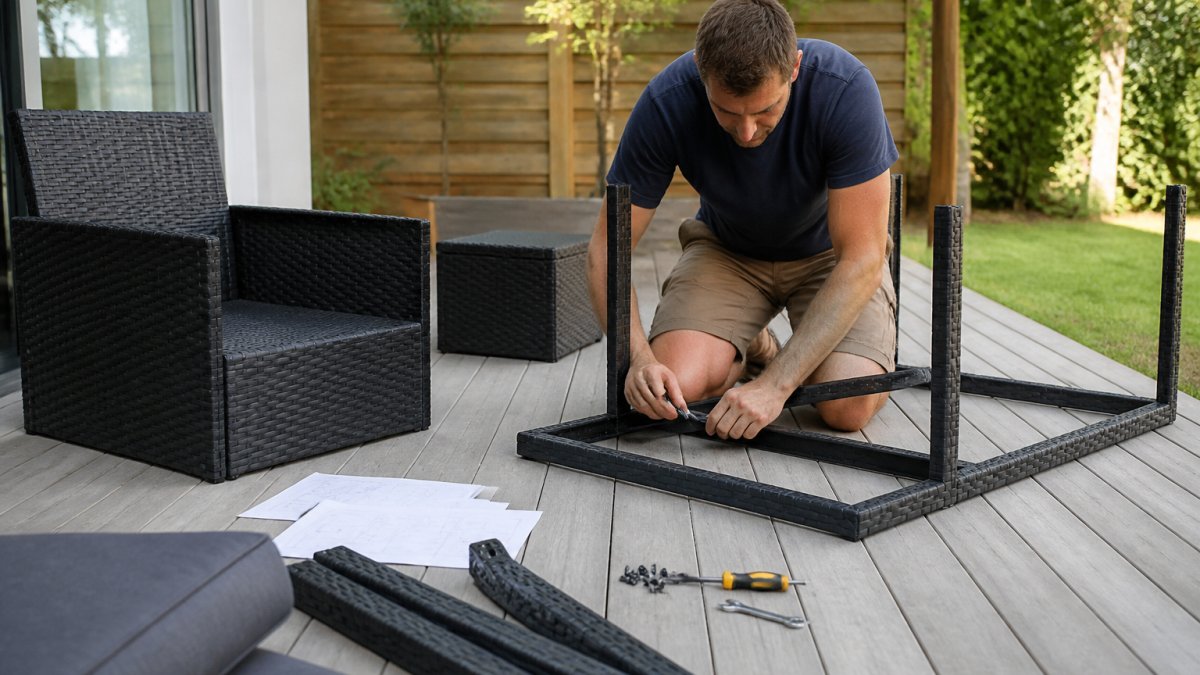
You need an Allen wrench, a screwdriver, and a wrench for most sets. A power drill with the right bits cuts the time down, but it is optional. The real question is not which tools to own, it is which tools earn their place in your kit and which ones cause damage when used wrong.
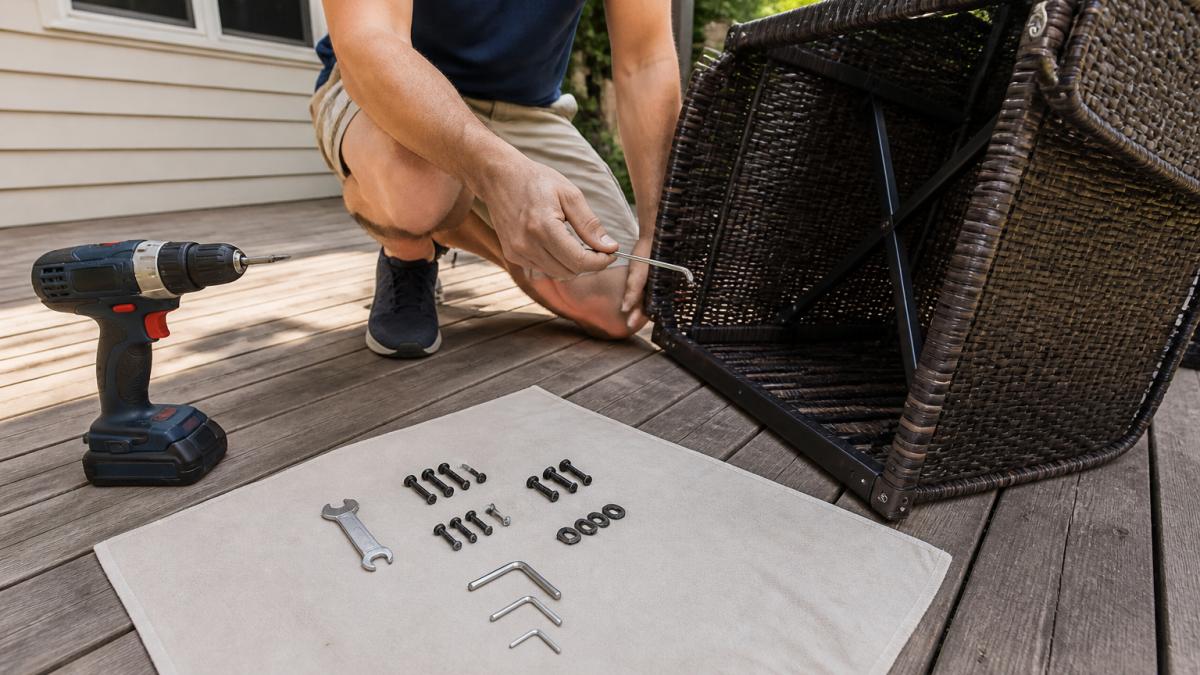
Here is the short list that covers almost every set, with the trade-off for each:
- Allen wrench (hex key), usually included. The included key works, but it is often short and thin. A longer-handled set gives you more leverage on stubborn bolts and costs very little. If the set includes one, keep it, but do not rely on it for a full sectional.
- Phillips and flathead screwdrivers. A medium Phillips handles most hardware. A stubby screwdriver helps in tight corners where a full-length handle will not fit.
- Adjustable wrench or a small socket set. A socket set is faster and less likely to round off bolt heads than an adjustable wrench. If you only buy one tool for this job, make it a socket set.
- Rubber mallet for seating joints. Wood and metal joints sometimes need a firm tap to seat. A metal hammer will dent or crack the finish, use rubber only.
- Power drill with hex and driver bits. This is the single biggest time-saver. A drill with a clutch setting prevents over-tightening, which is the most common cause of stripped hardware. Set the clutch low and let it stop when the bolt seats.
- Utility knife for opening boxes. A dull kitchen knife is how people slice through upholstery. Use a utility knife with a fresh blade and cut away from the furniture.
- A bowl or tray for loose hardware. Hardware rolls. A muffin tin or magnetic tray keeps bolts separated by step so you are not sorting through a pile at step 12.
What Comes in the Box (and What Doesn't)
Most sets ship with the hardware, an Allen wrench, and printed instructions. What they usually do not include is the screwdriver, wrench, or drill you will want. Some sets also skip the wrench entirely, assuming you have one.
Check the parts list before you start. Count the bolts, washers, and screws against the list. Missing hardware is common, and it is much easier to spot before assembly than halfway through. If something is missing, contact the retailer before you build, most will ship replacement hardware rather than have you return the whole set.
Do You Need to Buy Anything?
For a single chair or small table, the included Allen wrench and a screwdriver you already own are enough. For a sectional or multi-piece set, a socket set and a drill with a clutch are worth the investment, they pay for themselves in saved time and avoided stripped bolts. You do not need specialty furniture tools. A basic household kit plus one good socket set covers nearly every set on the market.
Can You Assemble Patio Furniture by Yourself?
Yes, one person can assemble most patio furniture alone. The main challenge is lifting and flipping heavy pieces, not the assembly steps themselves.
Sofas, sectionals, and large tables are the exceptions. Those pieces are easier and safer with a second set of hands. If you are solo, assemble on the ground and lift the finished piece into place rather than flipping it.
A few habits make solo work easier:
- Build on a flat, padded surface
- Leave bolts loose until the frame is square, then tighten
- Move the finished piece with a furniture dolly if you have one
- Take breaks on long builds to avoid rushing
Common Patio Furniture Assembly Mistakes and How to Fix Them
The most common patio furniture assembly mistakes are loose bolts, stripped hardware, and skipped steps. Each one is easy to avoid with a little care.
5-Piece Wicker Patio Furniture Set with Ottomans, Beige →
Watch for these:
- Over-tightening bolts. This strips threads and cracks wicker or wood. Tighten firmly, not with full force.
- Skipping the parts count. Missing pieces stall the build. Count first.
- Ignoring the order in the manual. Steps are sequenced for a reason. Jumping ahead causes rework.
- Building on a hard, dirty surface. This scratches finishes. Use a tarp.
- Forcing misaligned holes. If a hole will not line up, loosen nearby bolts, adjust, and retry.
Fixing a mistake usually means backing up a step or two. Loosen the surrounding hardware, realign the frame, and re-tighten in order.
Assembly Difficulty by Furniture Type and Experience Level
Difficulty tracks with part count and weight, not brand. A first-timer can handle a chair set. A sectional is a better second project. The problem with most difficulty labels is that they are vague. Here is a concrete way to rate the job before you start, using part count and weight as the two variables that actually predict how long and how frustrating the build will be.
A Practical Difficulty Scale
Use this scale to rate any piece before you open the box:
- Easy (under 15 parts, under 20 lbs per piece): Chairs, ottomans, end tables, coffee tables. One person, basic tools, no lifting risk. These are good first builds.
- Moderate (15-40 parts, 20-50 lbs per piece): Rocking chairs, swivel chairs, benches, picnic tables. One person can do it, but a second set of hands helps with flipping and aligning. Expect some steps where you need to hold two pieces while driving a bolt.
- Harder (40+ parts, 50+ lbs per piece): Sofas, sectionals, and full multi-piece sets. These involve large frames, multiple boxes, and pieces that are awkward to lift alone. A second person is strongly recommended, not just for speed but for safety.
Part count matters more than weight for time. A 60-part sectional with light aluminum frames still takes longer than a 20-part wooden bench because every bolt is a step. Weight matters more for safety and for whether you can build solo.
Matching the Job to Your Experience
If you are new to flat-pack furniture, start with the smallest piece in the set. It builds confidence and teaches you how the hardware works. A chair or end table is a fine first build.
A common pattern is that people underestimate sectionals because the individual pieces look simple. The complexity is in the repetition and the alignment, you are assembling five or six pieces that must line up into one frame.
Material matters too. Wicker and rattan sets hide hardware well and are forgiving of small alignment errors. Solid wood and metal frames are heavier and less flexible, so alignment matters more.
Our 5-Piece Wicker Patio Furniture Set with Ottomans is a good example: the listing notes it needs two people and about 2 hours or more, which sets a clear expectation up front.
When to Hire a Professional Assembler (and What It Costs)
Hiring a professional assembler makes sense for large sectionals, heavy tables, or when your time is better spent elsewhere. Costs vary by market, so get a local quote before you decide.
Most assembly services charge by the piece or by the hour. A simple chair costs less than a full sectional. Ask for a flat quote based on your exact set, not a general estimate.
Hiring helps most when:
- The set is large and heavy
- You lack the tools or the space to build safely
- You want it done in one visit
- The furniture needs to be placed and leveled
If you go the DIY route, our 7-Piece Rattan Sectional Set ships with hardware and instructions, and the listing notes it arrives in multiple boxes.

Patio furniture assembly is a manageable DIY job for most homeowners. The real challenge is not skill, it is patience, prep, and having the right tools on hand before the boxes arrive.
Frequently Asked Questions
How long does it take to assemble patio furniture?
Most small sets, like a two-chair set with a side table, take 30 to 45 minutes. Larger sets with a sofa, ottomans, and a coffee table typically run 2 to 3 hours. A 5-piece set from Backyard Comfort CO lists an approximate assembly time of 2 hours or more and recommends two people. Add time for unpacking, sorting hardware, and cleanup, especially on a first build.
What tools do you need to assemble patio furniture?
Most sets ship with an Allen wrench and basic hardware. A power drill with the correct bit, a rubber mallet, and a utility knife for cutting protective plastic wrap speed things up. A small bowl or magnetic tray keeps bolts and washers from rolling off the deck. A second pair of hands helps with sofas and sectionals, where aligning frames while tightening is the hard part.
Can one person assemble an outdoor sectional?
Sometimes, but it depends on the piece. Armless chairs and coffee tables are manageable solo. Corner loveseats and full sofas are heavier and awkward to line up, so a second person saves time and prevents stripped threads from forcing bolts at an angle. A 7-piece sectional set ships in multiple boxes with all hardware and instructions, and the larger frame pieces are where a helper matters most.
Should you tighten all the bolts before finishing assembly?
No. Thread every bolt finger-tight first, then go back and tighten them once the frame is square and all pieces are aligned. Tightening as you go locks the frame into whatever position it is in, which makes later holes harder to line up. This is one of the most common patio furniture assembly mistakes, and it usually shows up as a wobbly chair or a table that will not sit flat.