 ultimate-guide
Why Invest in Solid Wood Furniture: A 2026 Guide
Table of Contents
- Why Invest in Solid Wood Furniture? The Case for Pieces That Outlast Trends
- Solid Wood Furniture Pros and Cons
- Solid Wood vs Engineered Wood Furniture: What the Labels Actually Mean
- How Long Does Solid Wood Furniture Last?
- The Real Cost Over Time: A Buying Checklist and Species Comparison
- How to Care for Solid Wood Furniture in Every Season
- Conclusion: Matching the Material to How You Actually Live
- Frequently Asked Questions
Last Updated: October 14, 2026
Why Invest in Solid Wood Furniture? The Case for Pieces That Outlast Trends
Solid wood furniture is built from whole, kiln-dried lumber, and the case for it comes down to one idea: you buy it once. It holds its structure, looks, and value far longer than the glued-and-pressed alternatives in most showrooms.
The difference shows up in the joints, not the showroom. A solid piece can be sanded, refinished, and handed down; a particleboard piece usually can't be repaired at all.
Solid Wood Furniture Pros and Cons
Solid wood furniture offers unmatched strength and repairability, but it costs more upfront and asks for occasional maintenance.
The Advantages: Strength, Grain, and Long-Term Value
The structural stability of solid wood comes from the material itself. Grain runs the length of each board, so a solid leg or rail resists sagging and racking in a way a glued chip core cannot.
Then there's the aesthetic appeal. Every board carries its own grain pattern, color shift, and figure marks, so no two pieces look identical, and the surface develops a patina over time.
The Trade-Offs: Cost, Weight, and Upkeep
Real wood costs more, the honest trade-off for longevity. Weight is the second issue: solid pieces are heavy, which is good for stability and annoying on moving day, since a large table can take two or three people to shift. Upkeep is the third: wood outdoors needs periodic cleaning and, depending on species, occasional re-oiling. That's far less work than replacing a set every few seasons.
Solid Wood vs Engineered Wood Furniture: What the Labels Actually Mean
Solid wood furniture is made from whole boards cut from a single species, while engineered wood is built from wood particles, fibers, or thin slices bonded with adhesive. The label tells you what's inside, and the inside determines how long it lasts. But the story is more nuanced than "solid good, engineered bad", understanding the construction hierarchy helps you buy smarter at any price point.
The Construction Hierarchy: From Whole Boards to Sawdust
Solid wood means every visible part is cut from a single piece of lumber, with grain running continuously through the board's thickness.
Particleboard is sawdust and wood chips pressed together with resin.
MDF (medium-density fiberboard) is made from finer wood fibers and resin, giving it a smoother, denser surface than particleboard.
Plywood is layers of wood veneer glued with alternating grain directions.
Wood-plastic composites (WPC) blend wood fibers with plastic.
When Engineered Materials Make Sense
Engineered wood isn't automatically the wrong choice. It's the smarter buy in several situations:
- Flat-pack furniture on a budget. For a first apartment you'll leave in a few years, particleboard gets the job done at a low upfront cost.
- Painted pieces. MDF takes paint better than solid wood because it has no grain to fight.
- Wide panels. A solid wood tabletop wider than about 24 inches expands and contracts significantly with humidity. Plywood or veneered MDF resists that movement, which is why high-end dining tables often use a veneered top on a solid wood base.
- Outdoor furniture in extreme climates. WPC and HDPE handle freeze-thaw cycles and constant moisture better than most solid woods without annual maintenance.
The key is matching the material to the application. A veneered table on a solid wood base can be a fine piece of furniture; a particleboard desk labeled "wood" is not the same thing.
How to Tell What You're Actually Buying
Before you buy, inspect the piece or ask these questions:
- Look at the edges. Solid wood shows continuous grain through the thickness. Engineered wood shows a core of chips, fibers, or layers.
- Check the weight. Solid wood is heavy. If a large table feels light, it's probably hollow or engineered.
- Ask what the top, sides, and shelves are made of. A "solid wood" label sometimes means solid wood frame with veneered panels.
- Look at the joinery. Mortise-and-tenon, dovetail, and dowel joints suggest quality. Staples, cam locks, and screws into particleboard suggest a shorter lifespan.
- Read the finish description. "Wood finish" or "wood grain laminate" is not solid wood. Look for the species name, teak, oak, mahogany, cedar, and the word "solid."
How Long Does Solid Wood Furniture Last?
Solid wood furniture lasts for decades, often 20 to 50 years or more with basic care, while engineered and composite pieces typically last a handful of years before joints loosen or surfaces fail.
Three factors decide how long a piece lasts:
- Species hardness. Denser woods resist dents and scratches better than soft ones.
- Joinery quality. Mortise-and-tenon and similar joints outlast staples and cam locks.
- Exposure and care. Indoors, wood can last generations. Outdoors, it depends on the species and how often you maintain it.
Teak is a good example: naturally dense and resinous, which is why it's a common choice for outdoor furniture that has to handle weather. Our 10-Piece Teak Patio Furniture Set - Natural Gray is built from Grade A premium teak with textured wood grain, lasting natural resin, and all-weather stain and fade resistant machine washable cushions.

Repairability is what separates a 30-year piece from a 5-year one. A solid wood chair with a loose joint can be re-glued, re-doweled, or refinished. A particleboard chair with a stripped fastener hole usually goes to the curb.
The Real Cost Over Time: A Buying Checklist and Species Comparison
Total cost of ownership is where solid wood quietly wins. A cheaper set you replace two or three times costs more in the end than one solid set you maintain, plus repeated assembly, delivery, and disposal. Here's how common species compare:
| Species | Hardness | Weather Resistance | Best For | Care Level |
|---|---|---|---|---|
| Teak | High | Excellent, naturally oily | Patio sets, dining tables | Low to moderate |
| Excellent | Low | |||
| High | Moderate | |||
| Good | Moderate | |||
| Moderate | ||||
| Low | High |
Before you buy, run this checklist:
- Confirm the top, legs, and frame are solid, not veneered over a core
- Identify the species and check it suits your climate
- Inspect the joinery: mortise-and-tenon beats staples every time
- Check whether hardware is rust-resistant for outdoor use
- Ask what the finish is and how to renew it
- Confirm cushions and covers are replaceable
- Measure your space before ordering, especially on an oddly shaped patio
- Read the return and shipping terms so you're not stuck with a piece that doesn't fit
How to Care for Solid Wood Furniture in Every Season
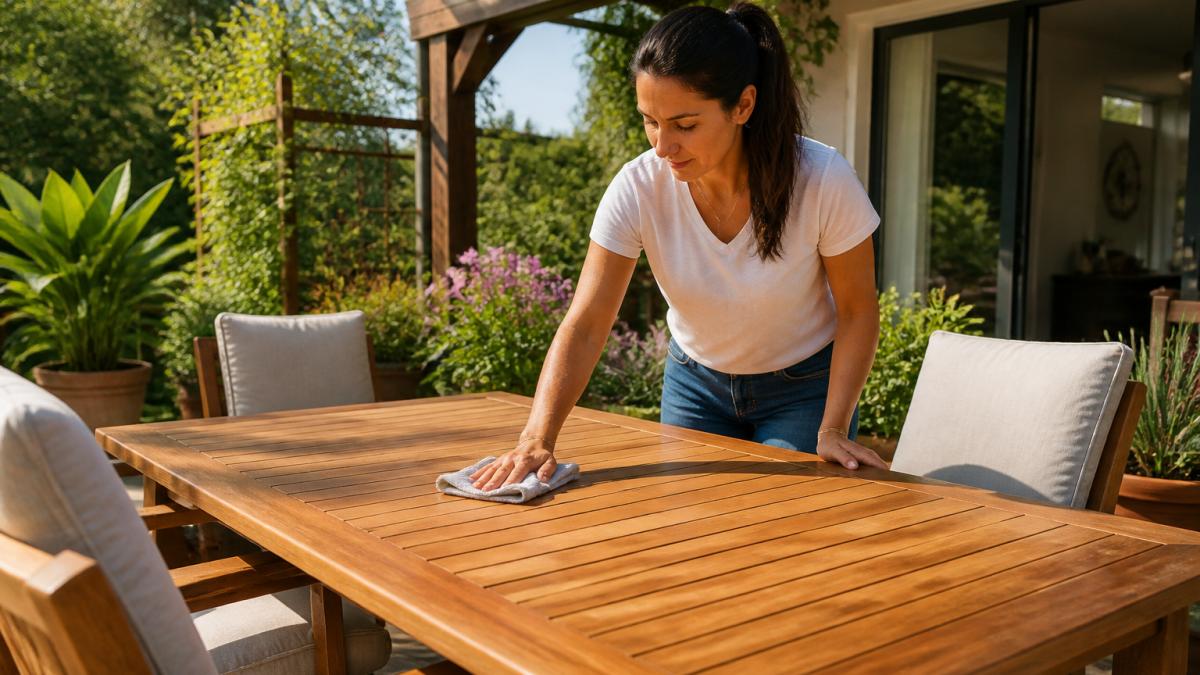
Caring for solid wood furniture comes down to managing moisture, sunlight, and surface wear, with the routine shifting by season. The goal is to keep the wood's moisture content stable so it doesn't swell, crack, or gray out, and to know how to fix the problems that will eventually happen.
Humidity: The Invisible Factor
Wood is hygroscopic, meaning it absorbs and releases moisture from the air. When indoor humidity swings, wood moves: dry winter air shrinks boards and opens joint gaps, while humid summer air swells boards that can cup or bow if restrained.
10-Piece Teak Patio Furniture Set – Natural Gray →
The fix is keeping indoor relative humidity between 30% and 50% year-round; a hygrometer tells you when to run a humidifier or dehumidifier. Outdoors, keep pieces off wet ground and ensure water drains away rather than pooling.
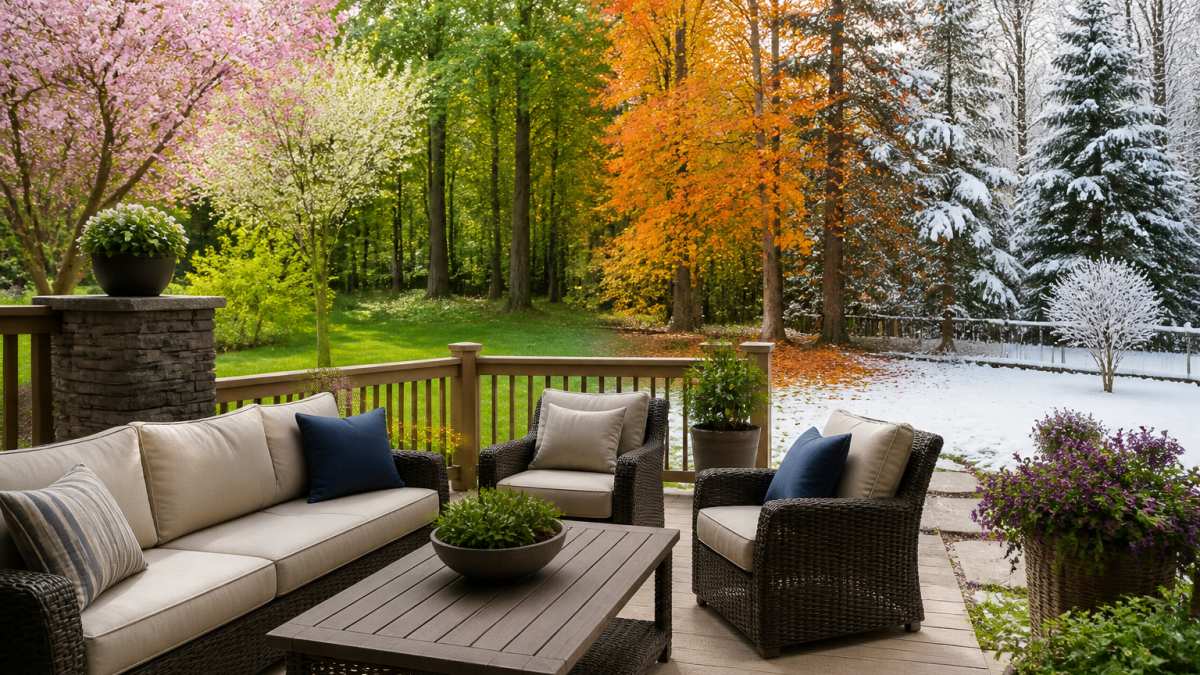
Seasonal Care by Climate
Spring. Clean with mild soap and water, let dry fully, then inspect joints and tighten loose hardware before heavy-use months.
Summer. Sun exposure is the main threat.
Fall. Clear debris from crevices and under cushions so moisture doesn't sit against the wood.
Winter. Cover or store pieces where practical and keep them off wet ground. In harsh climates, move cushions indoors.
How to Repair Common Problems
Even well-cared-for wood develops issues over time. Here's how to handle the most common ones:
Scratches. Light scratches in the finish can be buffed out with furniture polish or a matching touch-up marker. Deeper scratches can be filled with a wax stick or wood filler, then blended with a stain marker. For outdoor teak, light sanding with fine-grit paper followed by a teak protectant restores the surface.
Water rings and stains. A white ring from a wet glass is usually moisture trapped in the finish, not the wood.
Loose joints. A wobbly leg is usually a loose joint, not a broken one.
Cracks and splits. Small cracks are often seasonal and close when humidity rises.
Graying and fading. Outdoor wood grays over time as surface fibers break down, normal, not rot.
Refinishing: When and How
Solid wood can be refinished multiple times over its life, one of its biggest advantages over veneer or engineered wood.
Indoor pieces usually need a full refinish once a decade at most. Outdoor pieces may need re-oiling or resealing every year or two, depending on species and climate.
Before refinishing, test a small area to confirm the new finish is compatible with the old one.
For teak specifically, occasional light sanding followed by a cleaner and protectant restores the rich color. Our 7-Piece Outdoor Patio Dining Set with Teak HPL Tabletop & Rope Chairs pairs a deep teak rectangular table with handwoven textilene rope chairs and high-performance, fade-resistant, and waterproof cushions, which cuts down on seasonal upkeep.

If you want wood-look durability with even less maintenance, our 7-Piece Outdoor HDPE Dining Set, Teak captures the appearance of real wood while resisting cracking, peeling, and fading, and it carries a 20-year warranty on the frame.

Conclusion: Matching the Material to How You Actually Live
The right material depends on how you use your space, not on which option sounds best in theory.
We built Backyard Comfort CO around the first path. Our solid wood construction and weather-ready design handle every season, so you're not shopping for a replacement set in three years.
Get started with Backyard Comfort CO and turn your patio into a space that lasts.
Frequently Asked Questions
Is it worth buying solid wood furniture?
It depends on how long you plan to keep the piece. Solid wood furniture typically costs more upfront, but it can be sanded, refinished, and repaired instead of replaced. Over a decade or more, that repairability often makes the total cost lower than buying particleboard or veneer pieces every few years. If you move often or want to change styles frequently, a cheaper option may suit you better.
What are the downsides of solid wood furniture?
The main drawbacks are higher upfront cost, heavier weight, and more maintenance than plastic or composite alternatives. Solid wood also expands and contracts with humidity, so it can develop small cracks or movement if it sits in extreme conditions without care. It is not maintenance-free, but the upkeep is simple: clean it, protect the finish, and address scratches before they deepen.
How long does solid wood furniture last?
With reasonable care, solid wood furniture often lasts for decades, and some pieces get passed down between generations. Teak and other dense, naturally weather-resistant species hold up especially well outdoors because their natural oils resist rot and insects. The lifespan depends on the species, the finish, and how you maintain it, but repairability means a solid wood piece rarely needs to be thrown away.
Can solid wood furniture be repaired or refinished?
Yes, and that is one of its biggest advantages. Light scratches can be sanded out, deeper gouges filled, and the whole surface refinished to look new again. Teak specifically can be cleaned and treated with a protectant to restore its original color. Engineered wood and veneer cannot be sanded down the same way, so damage there usually means replacement instead of repair.