 ultimate-guide
Weather-Resistant Wood for Outdoor Structures
Table of Contents
- Why Weather-Resistant Wood Matters for Outdoor Structures
- Top Wood Species for Weather Resistance
- Understanding Wood Properties That Drive Durability
- How to Protect Patio Furniture and Wood Structures in Winter
- Long-Term Maintenance and Cost Comparison
- Choosing the Right Wood for Your Climate and Project
- Frequently Asked Questions
Why Weather-Resistant Wood Matters for Outdoor Structures
Your backyard is an extension of your home, and outdoor structures must survive rain, snow, UV rays, and temperature swings. Weather-resistant wood solves this problem by starting with materials that naturally withstand the elements. The difference between wood that lasts five years and wood that lasts 25 comes down to the inherent properties of the species you choose. Some woods have natural oils and dense grain structures that repel water and resist decay, while others absorb moisture like a sponge and rot from the inside out. At Backyard Comfort CO, we've built our entire pergola and furniture line around species that perform. Weather-resistant wood for outdoor structures isn't a luxury, it's the practical choice for anyone tired of constant maintenance and replacement cycles.
Top Wood Species for Weather Resistance
Cedar: Natural Decay and Insect Resistance
Cedar is the gold standard for outdoor wood applications. This softwood contains natural oils and extractive compounds that make it inherently resistant to decay, rot, and insect damage. The wood's cellular structure also resists moisture penetration better than many alternatives.
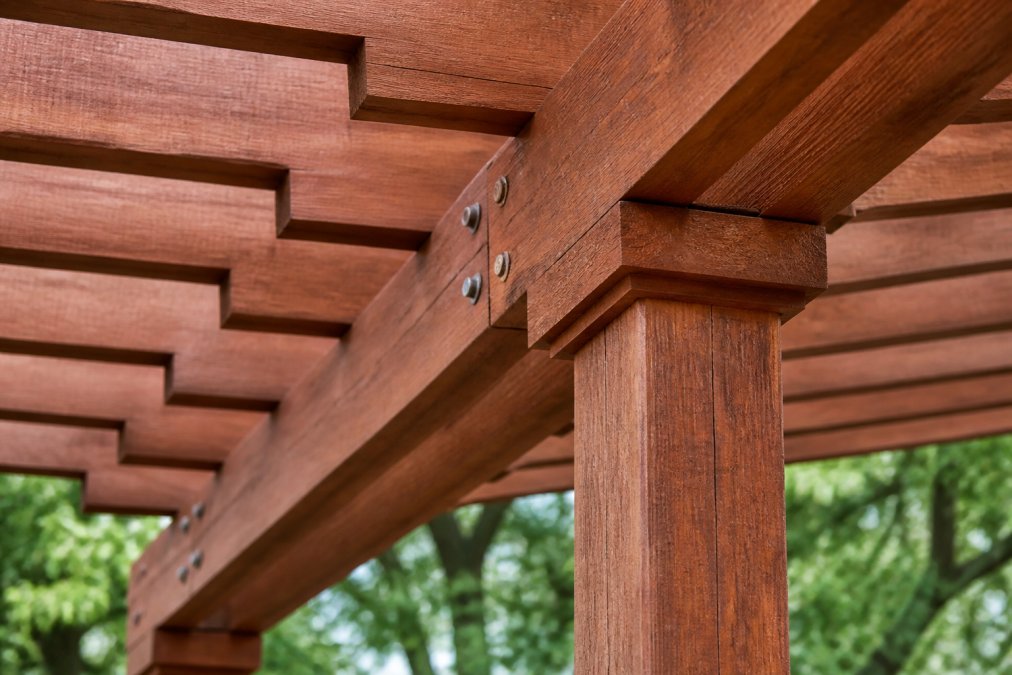
The heartwood of cedar, the dense, darker inner core, provides the durability. Sapwood, the lighter outer ring, lacks these protective properties and will deteriorate faster if exposed. Cedar's dimensional stability is another major advantage. Unlike wood that swells dramatically when wet and shrinks when dry, cedar maintains relatively consistent dimensions across seasons, meaning less warping, checking, and splitting over time.
One limitation: cedar requires maintenance. Without regular sealing or staining, the wood will weather to a silvery gray. Some homeowners love this look; others prefer to maintain the warm reddish-brown color with periodic refinishing. Either way, the wood underneath remains structurally sound.
Pressure-Treated Lumber vs. Cedar for Outdoor Structures
Pressure-treated lumber is the economical alternative to cedar. The wood is infused with chemical preservatives that prevent rot and insect damage, making it suitable for outdoor use at a lower price point. The trade-off is clear: pressure-treated wood requires more maintenance and doesn't age as gracefully. The chemicals can leach out over time, particularly in wet climates, and the wood tends to be less dimensionally stable than cedar, meaning more warping and splitting as moisture content fluctuates.
For structural applications where appearance matters less, like support posts or joists hidden beneath a deck, pressure-treated lumber makes financial sense. For visible structures like pergolas and furniture where you want the wood to look good for decades, cedar or hardwoods are worth the premium.
Hardwoods with Superior Durability
Tropical hardwoods like ipe, cumaru, and teak offer exceptional durability that exceeds cedar. These woods are extremely dense, with high extractive content that resists decay, insects, and weathering. Ipe has a Janka hardness rating above 3,500, making it harder than most domestic hardwoods. The downside is cost and sustainability concerns around harvesting. They're also difficult to work with, standard fasteners and tools can struggle with wood this dense. For most homeowners, the expense and complexity don't justify the marginal durability gain over cedar.
Thermally-Modified Timber as an Alternative
Thermally-modified timber is wood that's been heated to high temperatures without chemicals, which alters its cellular structure and improves durability. The process reduces moisture absorption, increases rot resistance, and improves dimensional stability. Thermally-modified wood bridges the gap between untreated softwood and chemically-treated lumber. It's more durable than cedar, requires less maintenance than pressure-treated wood, and avoids chemical concerns. The catch is availability and cost, it's harder to source in most regions.
Understanding Wood Properties That Drive Durability
Heartwood vs. Sapwood in Outdoor Applications
Heartwood is the dead inner core of a tree, where protective compounds, tannins, resins, and oils accumulate and resist decay and insects. Sapwood is the living outer ring that transports water and nutrients. It's lighter in color, less dense, and lacks the protective extractives that make heartwood durable. For outdoor structures, you want lumber with a high proportion of heartwood. Cedar and other decay-resistant species are valued specifically because their heartwood contains these protective compounds. Pressure-treated lumber works by artificially adding preservatives to sapwood, but it's never quite as resistant as naturally-protected heartwood.
Dimensional Stability and Moisture Content
Wood moves with moisture. When humidity increases, wood absorbs water and expands. When humidity drops, wood releases moisture and shrinks. This movement is one of the primary reasons outdoor wood fails. Species with high dimensional stability, like cedar and tropical hardwoods, have grain structures that minimize this movement. They absorb and release moisture more slowly and uniformly, reducing stress on joints and fasteners. Kiln-dried lumber has lower initial moisture content than air-dried wood, which reduces initial swelling. However, once the wood reaches equilibrium with outdoor humidity, the species' inherent ability to resist moisture-driven movement matters most.
How to Protect Patio Furniture and Wood Structures in Winter
Winter is when outdoor wood faces its harshest conditions. Freeze-thaw cycles drive water into the wood, where it expands and contracts with temperature swings. Start with sealing and staining before winter arrives. A quality exterior sealant creates a water-resistant barrier that reduces moisture absorption. Stain adds UV protection while allowing the wood to breathe, crucial because trapped moisture causes more damage than exposure.
Clear debris from horizontal surfaces. Leaves, pine needles, and standing water accelerate decay by trapping moisture against the wood. For patio furniture, consider storing pieces indoors during winter or covering them with breathable tarps. Backyard Comfort CO's pergolas are designed to remain in place year-round, but removable cushions and small accessories should be stored. If you use covers, ensure they're not plastic, plastic traps moisture against the wood and causes more damage than exposure. Remove snow and ice carefully with a soft brush rather than a shovel, which can gouge the wood surface and create entry points for water and decay.
Long-Term Maintenance and Cost Comparison
The true cost of outdoor wood is the total cost of ownership (TCO) over 10 to 25 years, including materials, labor, sealants, repairs, and eventual replacement. A cheaper piece that requires replacement every three years costs far more than a quality piece that lasts 25 years.
Maintenance Frequency by Wood Type and Climate
Cedar in Moderate Climates
- Initial sealing: Year 1 (required)
- Resealing: Every 3 years
- Annual inspection and cleaning: 2-4 hours
- Expected lifespan: 20-25 years
Cedar in High-Humidity Climates
- Initial sealing: Year 1 (required)
- Resealing: Every 2 years
- Annual inspection, debris removal, and mold prevention: 4-6 hours
- Expected lifespan: 15-20 years
Pressure-Treated Lumber in Any Climate
- Initial sealing: Optional
- Resealing: Every 3-4 years if sealed; none required if left natural
- Annual inspection and fastener checks: 1-2 hours
- Expected lifespan: 8-12 years
Thermally-Modified Timber in Any Climate
- Initial sealing: Year 1 (optional)
- Resealing: Every 4-5 years
- Annual inspection and cleaning: 2-3 hours
- Expected lifespan: 20-25 years
Tropical Hardwoods in Any Climate
- Initial sealing: Optional
- Resealing: Every 5+ years (if sealed for appearance only)
- Annual inspection and cleaning: 1-2 hours
- Expected lifespan: 25-40 years
Regional Maintenance Variation
High-Humidity Climates (Southeast, Gulf Coast, Pacific Northwest) Add 30-50% to maintenance costs and reduce expected lifespan by 20-30%. Mold, mildew, and fungal growth accelerate decay. Resealing every 2 years is necessary. Cedar's advantage shrinks in these climates; hardwoods and thermally-modified timber become more cost-effective.
Freeze-Thaw Climates (Northeast, Upper Midwest, Mountain West) Add 20-40% to maintenance costs due to freeze-thaw damage and fastener corrosion. Winter protection becomes essential. Dimensional stability matters more than rot resistance; thermally-modified timber and hardwoods outperform cedar.
Arid Climates (Southwest, High Plains) Maintenance costs are lowest, but UV degradation is severe. Sealing protects finish but doesn't prevent checking and splitting. Any wood works here; cost is the primary driver.
Labor Costs: DIY vs. Professional Maintenance
Sanding, staining, and sealing a 12 ft. × 12 ft. structure takes 8-16 hours for a homeowner. Professional work adds significant cost over 10 years. DIY maintenance saves labor costs but requires time, equipment, and skill. Many homeowners underestimate the difficulty and end up with poor results that accelerate wood degradation.
Choosing the Right Wood for Your Climate and Project
Different climates impose different stresses on outdoor wood. Humidity drives rot and fungal growth. Freeze-thaw cycles cause dimensional instability and fastener failure. UV radiation degrades finishes and causes checking. Choosing the right wood means matching the wood's strengths to your climate's primary threat.
Climate-Specific Wood Selection Guide
High-Humidity Climates (Southeast, Gulf Coast, Pacific Northwest, Hawaii)
Primary threat: Fungal decay, mold, mildew, insect damage
In these regions, moisture is constant. Wood that absorbs water quickly will rot from the inside out, regardless of surface sealing. Rot resistance is non-negotiable.
-
Best choice: Tropical hardwoods (Ipe, Cumaru, Teak)
- Why: Extremely high extractive content and low moisture absorption. Ipe has a moisture absorption rate of 8-12%, compared to cedar's 15-20%. In humid climates, this difference translates to 5-10 extra years of durability.
-
Second choice: Thermally-Modified Timber
- Why: Heat treatment reduces moisture absorption to 10-14%, improving rot resistance without chemicals. Easier to source than tropical hardwoods and more sustainable.
-
Third choice: Cedar (Heartwood-Rich)
- Why: Natural decay resistance is reliable, but humidity shortens lifespan to 15-20 years instead of 20-25.
-
Avoid: Pressure-Treated Lumber
- Why: Chemical preservatives don't prevent the dimensional instability that humidity causes. Pressure-treated wood swells and shrinks dramatically with moisture fluctuations, leading to warping, fastener failure, and joint separation.
Freeze-Thaw Climates (Northeast, Upper Midwest, Mountain West, High-Altitude Regions)
Primary threat: Freeze-thaw cycles, dimensional instability, fastener corrosion
Water expands 9% when it freezes. If water penetrates wood and freezes, it forces the wood apart from the inside. Dimensional stability is more important than rot resistance in these climates.
-
Best choice: Thermally-Modified Timber
- Why: Heat treatment reduces moisture absorption and improves dimensional stability. The wood expands and contracts less with temperature and humidity swings, reducing stress on joints and fasteners.
-
Second choice: Tropical Hardwoods (Ipe, Cumaru)
- Why: Extreme density and low moisture absorption mean minimal swelling and shrinking. Fasteners stay tight, joints remain stable through winter.
-
Third choice: Cedar (Heartwood-Rich)
- Why: Decent dimensional stability compared to softwoods. Reliable choice if budget is limited.
-
Avoid: Pressure-Treated Lumber
- Why: Poor dimensional stability makes freeze-thaw damage worse. Constant movement loosens fasteners, separates joints, and creates gaps where water enters.
Arid Climates (Southwest, High Plains, Interior West)
Primary threat: UV degradation, checking and splitting
In dry climates, the main problem is not rot but weathering. Wood dries out, shrinks, and cracks as the surface weathers. Rot resistance is less critical; finish protection and dimensional stability matter more.
-
Best choice: Any outdoor wood (cost-driven)
- Why: Rot is unlikely; choose based on budget and appearance preference. Pressure-treated lumber is economical. Cedar is attractive. Hardwoods are durable but overkill.
-
Second choice: Cedar
- Why: Natural appearance, moderate cost, decent durability. The wood will weather to silvery gray without sealing, which many homeowners find attractive.
-
Third choice: Pressure-Treated Lumber
- Why: Lowest cost, adequate durability in dry climates. Rot is not a concern.
-
Consider: Thermally-Modified Timber
- Why: If you want low maintenance and good appearance, thermally-modified timber is a solid middle ground. Requires less frequent sealing than cedar, lasts longer than pressure-treated.
Project-Type Recommendations
Pergolas and Large Structures (Visible, Load-Bearing)
These structures are permanent installations that define your outdoor space. Appearance and durability matter equally. Cedar is the standard choice for most regions (except humid and freeze-thaw climates, where hardwoods or thermally-modified timber are better). Pressure-treated lumber is acceptable for structural posts and hidden framing, but visible surfaces should be cedar or better. Thermally-modified timber is an excellent choice if you want lower maintenance than cedar and can source it locally. Proper construction, correct fasteners, adequate drainage, proper ventilation, affects durability as much as wood choice.
For a durable and inviting centerpiece for your backyard, consider the 12X24 FT Premium Cedar Wood Pergola with Trellis Roof & Weather-Resistant Support or the 10 Ft. X 10 Ft. Traditional All Cedar Wood Outdoor Patio Pergola Shade Structure. Both are crafted from solid cedar, designed to withstand the elements and provide a lasting retreat.


Patio Furniture and Smaller Pieces (Portable, Visible)
Furniture is more exposed to weather than structures and is often replaced more frequently. Cedar is ideal: attractive, durable enough for 10-15 years, and easy to refinish if needed. Pressure-treated lumber is acceptable for frames and hidden components but looks industrial on visible surfaces. Hardwoods are overkill for furniture unless you're building heirloom pieces. Thermally-modified timber is a good choice if you want furniture that requires minimal maintenance.
Decking (High-Traffic, High-Moisture Exposure)
Decks experience constant foot traffic, standing water, and moisture from below. Dimensional stability and rot resistance are critical. Pressure-treated lumber is the standard choice for decking. Cedar is acceptable in dry climates but not ideal for high-moisture areas. Thermally-modified timber is an excellent choice if budget allows; superior to pressure-treated in freeze-thaw climates. Tropical hardwoods are premium options for high-end decks but are expensive and difficult to install.
Installation Considerations
Wood choice is only half the equation. Installation quality determines whether the wood reaches its expected lifespan. Proper fastener selection (stainless steel or hot-dipped galvanized, not standard steel), adequate spacing for drainage, and correct joinery affect durability as much as wood species. DIY installation is feasible for furniture and smaller pieces if you have basic carpentry skills.
Avoid pressure-treated lumber for visible surfaces unless you plan to paint or stain it. The greenish tint is difficult to hide and doesn't improve with age. Plan for drainage and ventilation, wood that sits in standing water or is trapped against concrete will rot regardless of species. Elevate structures, ensure water runs off, and allow air circulation underneath.
Frequently Asked Questions
What is the best type of weather-resistant wood for outdoor use?
Cedar stands out for natural decay and insect resistance thanks to its extractive content, making it ideal for pergolas and furniture. Pressure-treated lumber offers chemically enhanced rot resistance at a lower cost. For maximum durability, hardwoods like ipe or cumaru provide superior rot resistance and dimensional stability, though they cost more. Your choice depends on your budget, climate, and maintenance tolerance.
How do I protect patio furniture and wood structures in winter?
Apply a protective sealant or stain before winter arrives to shield wood from moisture and UV damage. Use waterproof covers for furniture you won't use seasonally. Ensure proper drainage around pergolas and deck structures to prevent water pooling. In harsh climates, consider moving smaller pieces indoors. Regular inspection for checking and splitting helps catch damage early before winter weather worsens it.
Is pressure-treated lumber better than cedar for outdoor structures?
Pressure-treated lumber resists rot and termites through chemical treatment, costs less upfront, and offers good durability. Cedar offers natural resistance, requires less chemical treatment, and ages gracefully with a silver patina. Pressure-treated suits budget-conscious projects and wet environments; cedar works better for visible structures where natural appearance matters. Both outperform untreated softwood significantly.
What causes wood to rot outdoors, and how can I prevent it?
Fungal growth thrives in moisture, warmth, and poor air circulation. Prevent rot by choosing naturally decay-resistant species, maintaining proper drainage, sealing exposed surfaces, and allowing airflow around structures. Heartwood naturally resists decay better than sapwood due to higher extractive content. Regular maintenance including staining and sealing extends the life of any outdoor wood structure significantly.
This article was written using GrandRanker