 ultimate-guide
Durable Outdoor Furniture for Humid Climates: 2026 Guide
Table of Contents
- Why Humidity Destroys Outdoor Furniture
- Best Materials for Durable Outdoor Furniture in Humid Climates
- Teak vs Aluminum Outdoor Furniture: Which Handles Humidity Better?
- How to Prevent Mold on Patio Furniture
- How to Protect Patio Furniture Winter and Year-Round in Humid Climates
- Hardware Corrosion and Micro-Climate Maintenance Schedules
- Conclusion
- Frequently Asked Questions
Last Updated: September 12, 2026
Why Humidity Destroys Outdoor Furniture
Humidity destroys outdoor furniture through a slow process of moisture absorption, oxidation, and biological growth. Wood swells and cracks as it cycles between wet and dry, metal hardware corrodes, and damp cushions become breeding grounds for mold. This guide from Backyard Comfort CO breaks down which materials survive humid climates and which ones quietly fall apart.
The mechanism is straightforward. Moisture penetrates porous surfaces, then expands when temperatures rise and contracts when they fall. Repeat that cycle through a few seasons and structural integrity erodes from the inside. Cushions and upholstery hold water against frames, trapping dampness where air cannot reach. That trapped moisture is what turns a two-year-old set into a replacement project.
What most guides miss is that humidity rarely works alone. Salt air exposure in coastal environments accelerates corrosion on fasteners and welds. Intense UV breaks down finishes that would otherwise shield the material underneath (nist.gov). The combination is what shortens patio furniture longevity, not any single factor.

Below, we'll show you exactly which materials hold up, how to prevent mold, and how to protect your investment year-round.
Best Materials for Durable Outdoor Furniture in Humid Climates
The best materials for humid climates are HDPE poly lumber, teak wood, powder-coated aluminum, and synthetic wicker. Each resists moisture differently, and the right pick depends on your budget, maintenance tolerance, and how much sun your space gets.

| Material | Moisture Resistance | Maintenance | Best For |
|---|---|---|---|
| HDPE poly lumber | High, non-porous | Soap and water only | Maintenance-free households |
| Teak wood | High, natural oils | Annual oiling | Traditional look, coastal patios |
| Powder-coated aluminum | High, rust-proof | Occasional rinse | Lightweight, modern setups |
| Synthetic wicker | Moderate to high | Occasional rinse | Covered porches, UV-stabilized weave |
HDPE Poly Lumber: The Maintenance-Free Performer
HDPE poly lumber is a resin-based material made from high-density polyethylene, and it does not absorb water. That single property makes it the most forgiving option in humid climates. It will not rot, splinter, or grow mold on its surface, and cleaning takes soap and water.
A common mistake is assuming all poly lumber is equal. Cheap versions use less UV-stabilized pigment and fade within a few seasons. Heavy-duty construction matters here.
Our 7-Piece Outdoor HDPE Dining Set in Teak delivers that wood look without the upkeep. For a smaller footprint, the 6-Piece HDPE Dining Set with Bench offers the same polymer lumber durability.

Teak Wood: Natural Moisture Resistance With Upkeep
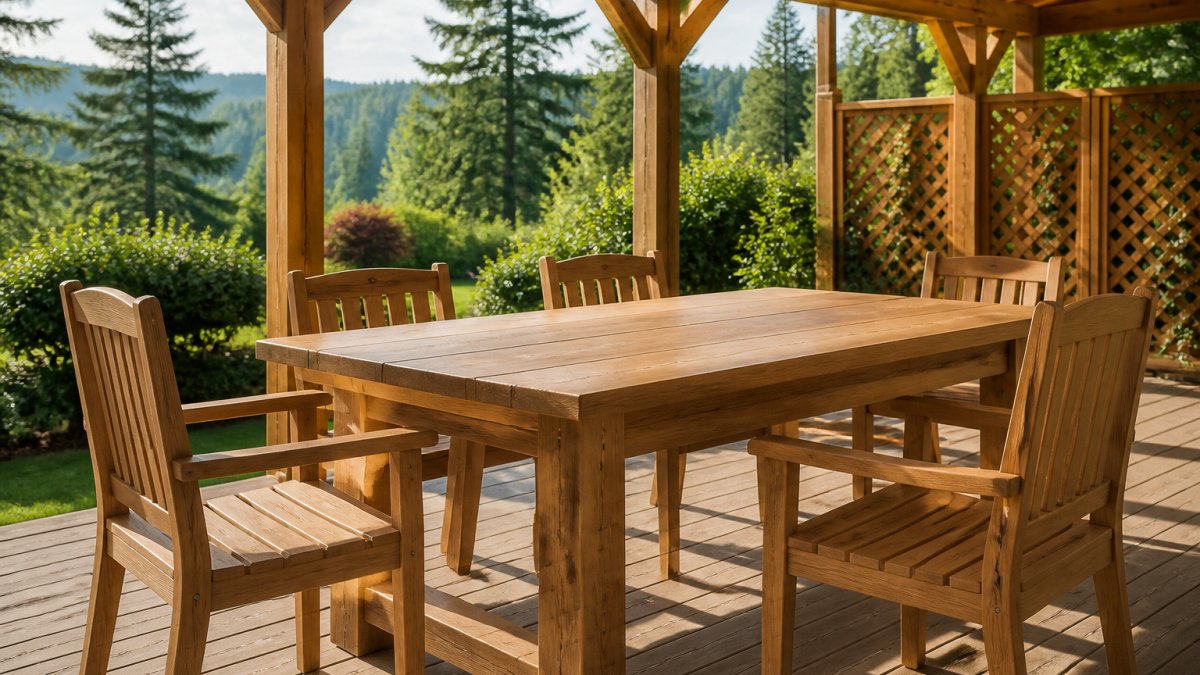
Teak wood earns its reputation honestly. Its natural oils make it hydrophobic, so water beads rather than soaking in. FSC-certified teak from responsibly managed forests holds up to wet weather better than most hardwoods.
The trade-off is maintenance. Teak needs annual oiling to keep its golden tone, or it weathers to a silver-gray patina. Neither outcome is failure, but the color is your choice, not the wood's.
Our 10-Piece Teak Patio Furniture Set - Natural Gray shows how teak ages gracefully in humid conditions when properly cared for.
Powder-Coated Aluminum: Lightweight and Corrosion-Resistant
Powder-coated aluminum is rust-proof by nature. The coating adds a weather-resistant finish that defends against oxidation and salt air exposure. It weighs far less than wood or polymer, which matters if you rearrange your outdoor living space often.
The weakness is the coating itself. Chips expose bare aluminum, and while aluminum does not rust the way steel does, the finish degrades. Touch up scratches when you spot them.
Synthetic Wicker vs. Natural Rattan
Synthetic wicker outperforms natural rattan in humid climates by a wide margin. Natural rattan absorbs moisture, warps, and grows mildew. Synthetic wicker, typically woven over an aluminum frame, resists all three when the weave is UV-stabilized.
Check the frame underneath before buying. A great weave over a steel frame will still corrode at the joints.
Teak vs Aluminum Outdoor Furniture: Which Handles Humidity Better?
Aluminum handles humidity better with less effort; teak handles it better with more character. But the real answer depends on how you use your space, how much maintenance you tolerate, and whether salt air is in the mix. Here is the breakdown that most guides skip.
Moisture behavior. Aluminum is non-porous and will not absorb water, swell, or crack. Teak absorbs some moisture but its natural oils make it hydrophobic, so water beads and runs off. In sustained humidity, teak expands and contracts slightly with the seasons, which can loosen joints over time if the furniture is not built with movement in mind. Aluminum does not move.
Corrosion risk. Aluminum does not rust, but it can oxidize and pit in coastal salt air if the powder coating is compromised. Teak has no metal to corrode, but its stainless steel fasteners can still fail if they are lower-grade. Check the hardware spec before you buy either.
Weight and stability. Teak is heavy and stays put in wind. Aluminum is light and easy to rearrange, but that same lightness means it can shift in strong storms unless you add weighted bases or tie-downs. If you live in a windy coastal area, teak's mass is a functional advantage, not just an aesthetic one.
Heat retention. In direct sun, dark aluminum frames can become uncomfortable to touch. Teak stays cooler because wood conducts heat more slowly. If your patio gets full afternoon sun, this matters more than most buyers expect.
Maintenance reality. Aluminum needs an occasional rinse and touch-up paint on chips. Teak needs annual oiling if you want the golden tone, or you can let it weather to silver-gray. Neither is hard, but teak asks for a recurring commitment.
Cost over time. Teak typically costs more upfront but can last decades with care. Aluminum costs less initially and holds up well, but powder coating may need refinishing after several years in harsh sun. The cheaper option is not always the lower total cost.
The micro-climate factor. A covered porch changes the calculus. In a dry, shaded space, both materials perform similarly. In an open, salt-heavy coastal exposure, aluminum's coating is the weak point and teak's fasteners are the weak point. Match the material to the specific stresses your space creates.
How to Prevent Mold on Patio Furniture
Preventing mold on patio furniture comes down to airflow, dryness, and cleaning frequency. Mold needs moisture and still air. Remove either and it cannot establish itself. But the hidden failure point is not the surface you see, it is the foam inside cushions and the crevices where frames meet.
Understand the mechanism. Mold spores are always present in outdoor air. They only colonize when relative humidity stays above 60% for extended periods and the surface stays damp for more than 24 to 48 hours (the EPA). In humid climates, that window is easy to hit after a single rainy day. The goal is to break the wet-dry cycle before it starts.
Material-specific risks.
- HDPE poly lumber: Non-porous, so mold grows only on surface dirt. A soap-and-water wipe removes it.
- Teak: Natural oils resist mold, but dirt and pollen can feed it. Clean with a soft brush and mild soap.
- Powder-coated aluminum: The coating resists mold, but water can pool in joints and seams. Dry those areas after storms.
- Synthetic wicker: The weave traps moisture in the gaps. A quick rinse and air-dry after rain prevents buildup.
- Cushions: The real danger. Foam absorbs water and holds it against the fabric backing. Once mold roots into foam, no surface cleaning removes it.
Cushion strategy. Choose all-weather fabric with a mildew-resistant backing, but do not trust the label alone. Store cushions indoors or in a breathable storage bag when not in use. If you leave them out, prop them on edge after rain so water drains and air circulates. Never stack wet cushions.
Cleaning schedule for humid climates.
- Wipe frames dry after heavy rain, especially at joints and seams.
- Clean with a mild soap solution monthly during peak humidity season.
- For coastal areas, rinse hardware and frames biweekly to remove salt residue that traps moisture.
- Inspect cushion seams and underside monthly. Early detection is the only reliable cure.
Tempered glass tabletops. Water pools at the frame edge and can seep underneath, creating a dark, damp micro-climate. Dry the rim after storms and check the gasket or spacer between glass and frame.
Eco-friendly disposal note. If mold does ruin a cushion or a piece of furniture, plan for end-of-life. HDPE poly lumber is recyclable through many municipal programs. Teak can be composted or repurposed. Do not send synthetic materials to a landfill if a recycling option exists.
How to Protect Patio Furniture Winter and Year-Round in Humid Climates
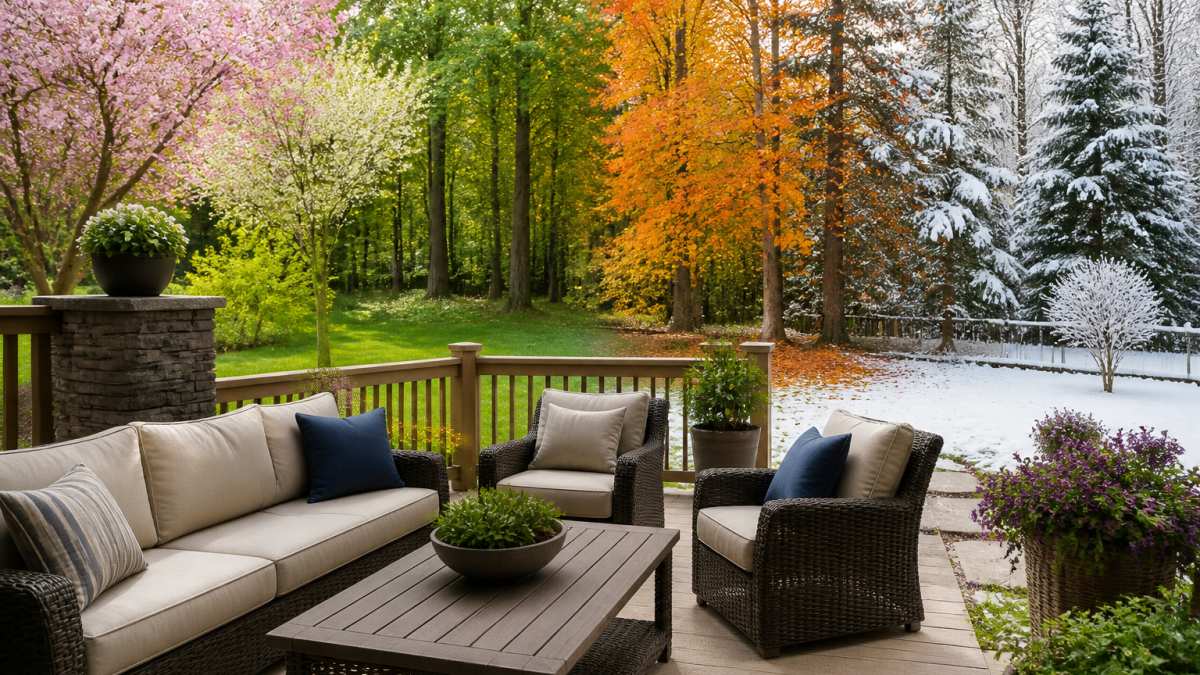
Protecting patio furniture in humid climates is less about winter and more about the shoulder seasons. In humid regions, the threat is year-round dampness rather than freezing alone.
Start with a micro-climate assessment. A covered porch, an open deck, and a poolside slab each hold moisture differently. Covered spaces dry faster and need less intervention. Open, shaded areas stay damp longest and demand the most attention.
Use breathable covers rather than fully sealed ones. Sealed covers trap condensation against the surface, which defeats the purpose. If you store furniture for the off-season, elevate it off concrete and leave gaps between pieces for air movement.
Hardware Corrosion and Micro-Climate Maintenance Schedules
Hardware is where humid-climate furniture fails first, and it is the part most buyers never inspect. Stainless steel hardware resists corrosion far better than standard zinc-plated bolts, which pit and seize within a season or two in coastal air (nace.org).
Build a schedule around your micro-climate rather than the calendar:
| Micro-Climate | Hardware Check | Frame Cleaning | Cushion Care |
|---|---|---|---|
| Covered porch | Every 6 months | Every 3 months | Monthly |
| Open deck, inland | Every 3 months | Monthly | Biweekly |
| Coastal, salt air | Monthly | Biweekly | Weekly |
For coastal environments, rinse hardware with fresh water monthly to remove salt residue. Salt air exposure is the single biggest accelerator of corrosion, and a rinse costs nothing.
Conclusion
Choosing furniture that survives humid air is a decision you make once, not a chore you repeat every few seasons. The right material, matched to your space and maintained on a realistic schedule, keeps your outdoor living space inviting year after year.
Backyard Comfort CO builds pieces for exactly that outcome, with solid wood construction, weather-ready design, and materials selected to handle every season. Most orders ship free within the continental U.S., and a 30-day return policy means you can commit without risk.
Get started with Backyard Comfort CO and turn your patio into a permanent retreat, not a recurring expense.
Frequently Asked Questions
What is the best material for patio furniture in a humid climate?
High-density polyethylene (HDPE) poly lumber performs best in humid climates because it does not absorb moisture, rot, or grow mold. Powder-coated aluminum is a close second, offering rust-proof performance with stainless steel hardware. FSC-certified teak wood resists moisture naturally thanks to its oils, but it requires periodic cleaning and oiling to maintain its appearance. Synthetic wicker over aluminum frames also holds up well. Avoid untreated softwoods and natural rattan, which absorb water and break down quickly in humid conditions.
Does wood furniture rot in high humidity?
Untreated wood furniture can rot in high humidity because wood fibers absorb moisture, creating conditions for mold and decay. However, naturally rot-resistant species like FSC-certified teak contain oils that repel water and resist fungal growth. Even teak benefits from annual cleaning and oiling to preserve its moisture resistance. HDPE poly lumber offers the look of wood without any moisture absorption, making it a low-maintenance alternative for homeowners who want to avoid refinishing.
How do I prevent mold and mildew on my outdoor furniture?
Preventing mold on patio furniture starts with choosing moisture-resistant materials like HDPE, powder-coated aluminum, or teak. Clean surfaces monthly with a mild soap-and-water solution, then dry thoroughly. Avoid trapping moisture under covers; use breathable all-weather fabric covers or store cushions indoors during wet spells. Elevate furniture off wet ground and ensure good air circulation around pieces. For cushions, choose mildew-resistant, quick-drying outdoor upholstery and bring them inside when not in use.
Is aluminum or teak better for humid environments?
Both work well, but they suit different priorities. Powder-coated aluminum is lightweight, rust-proof, and needs almost no maintenance, making it ideal for coastal environments with salt air exposure. Teak is heavier, naturally moisture-resistant, and develops a silver-gray patina over time if left untreated. Teak requires annual cleaning and optional oiling to maintain its golden color. For a maintenance-free option in extreme humidity, aluminum wins. For a natural wood look with proven outdoor longevity, teak is the better choice.