
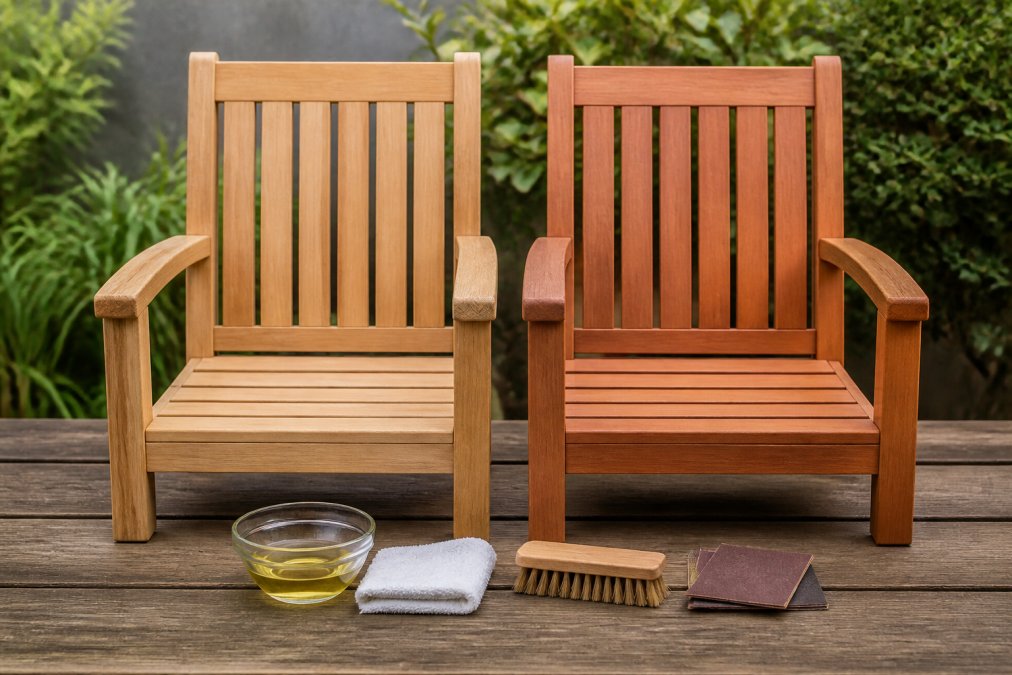
 comparison
Teak vs Cedar Outdoor Furniture Maintenance: 2026 Guide
Table of Contents
- Teak vs Cedar Outdoor Furniture: Quick Comparison
- How Teak and Cedar Weather Over Time
- Rot, Insects, and Climate: Which Wood Holds Up
- Teak Oil vs Sealer for Outdoor Furniture
- How to Protect Patio Furniture in Winter
- A Seasonal Maintenance Calendar for Teak and Cedar
- What Teak and Cedar Maintenance Really Costs
- Conclusion: Choosing the Wood You'll Maintain
- Frequently Asked Questions
Last Updated: September 25, 2026
Teak vs Cedar Outdoor Furniture: Quick Comparison
Teak vs cedar outdoor furniture maintenance comes down to one trade-off: teak asks for almost nothing and gives you decades, while cedar asks for more attention and rewards you with a lighter upfront cost.
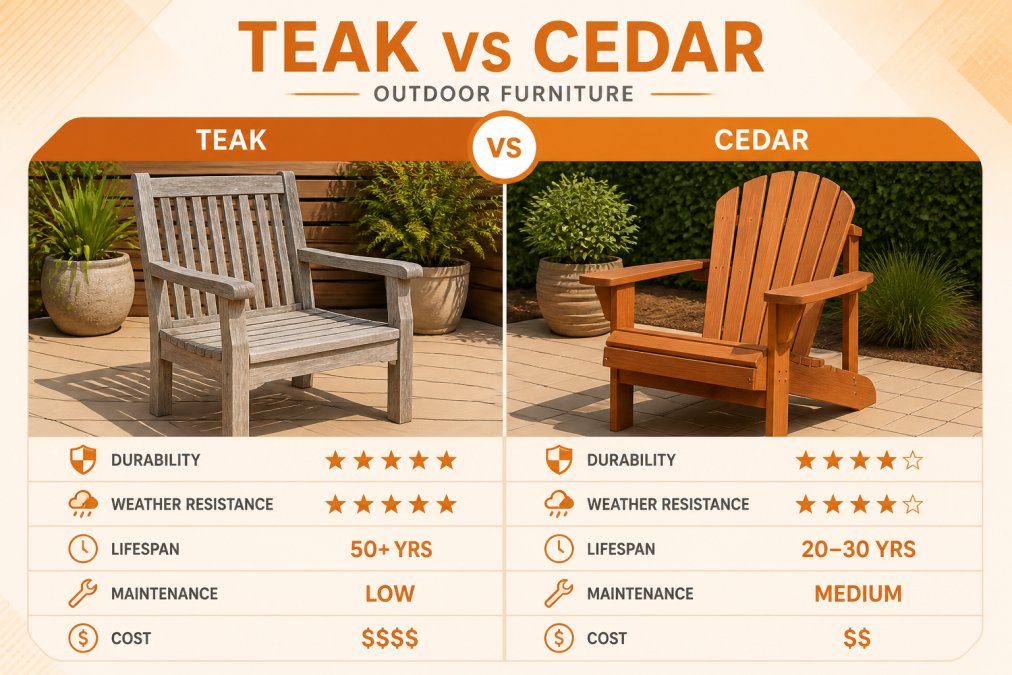
| Factor | Teak | Cedar |
|---|---|---|
| Density | High, tight grain | Lower, open grain |
| Natural oils | Abundant | Moderate |
| Color when new | Golden brown | Reddish brown |
| Color over time | Silver-gray patina | Gray, more uneven |
| Rot resistance | Excellent | Good |
| Insect resistance | Strong | Moderate |
| Typical upkeep | Cleaning, occasional oiling | Sealing every 1-2 years |
| Best for | Low-effort, long-term owners | Budget-conscious, hands-on owners |
How Teak and Cedar Weather Over Time
Teak weathers into a silver-gray patina. Cedar fades toward gray too, but faster and less evenly, because its grain absorbs moisture at different rates.
Spotting Teak and Cedar by Grain and Color
Look at the end grain first. Teak shows tight, dense growth rings with an oily sheen. Cedar shows wider rings, a softer surface, and a distinct smell when scratched.
Rot, Insects, and Climate: Which Wood Holds Up
Teak holds up better against rot and insects. Its density and natural oils make it hard for fungal decay to take hold and hard for termites to chew through.
Climate suitability tips the scales in different directions:
- Humid, rainy climates: Teak wins. Cedar needs more airflow and more frequent sealing.
- Dry, intense-sun climates: Both do well, but cedar grays and checks faster without a UV-blocking finish.
- Freeze-thaw regions: Teak's tighter grain handles repeated expansion and contraction better. Cedar benefits from a water-repellent sealant before winter.
Teak Oil vs Sealer for Outdoor Furniture
Teak oil feeds the wood; a sealer blocks water. That's the cleanest way to think about this choice.
| Product | What It Does | Reapply | Best On |
|---|---|---|---|
| Teak oil | Nourishes, restores color | 1-2x per season | Teak, dense hardwoods |
| Tung oil | Penetrates, adds mild water resistance | 1-2x per year | Teak, cedar |
| Water-repellent sealer | Blocks moisture, slows graying | Annually | Cedar, softer woods |
| Film finish | Builds a surface coat | Every 2-3 years | Cedar, sheltered pieces |
How to Protect Patio Furniture in Winter
Winter protection starts with cleaning, then drying, then covering correctly. Skip any step and you undo the others.
- Clean the surface. Wash with mild soap and water, then rinse. Mildew and dirt trapped under a cover become stains by spring.
- Let it dry completely. Two full dry days minimum. Covering damp wood traps moisture and invites mildew growth.
- Apply protection. Oil teak if you want to hold its color. Seal cedar with a water-repellent product.
- Raise it off the ground. Use blocks or a pallet so air moves underneath.
- Cover with breathable material. A tarp that traps condensation is worse than no cover at all. Look for a cover that vents.
- Store cushions indoors. Even all-weather cushions last longer out of the freeze-thaw cycle.
A Seasonal Maintenance Calendar for Teak and Cedar
Most maintenance advice online is anecdotal, someone in a dry climate says "oil once a year," someone in a humid one says "never oil," and both are right for their yard. A fixed schedule beats reacting to problems, but it has to match your climate. Here's a calendar for three broad climate zones, with cedar-specific tasks called out.
Identify Your Climate Zone First
- Humid / rainy zone (Southeast, Gulf Coast, Pacific Northwest): High moisture, mildew pressure, short drying windows.
- Dry / intense-sun zone (Southwest, high plains): Low moisture, high UV, fast graying and checking.
- Freeze-thaw zone (Midwest, Northeast, mountain West): Repeated expansion and contraction, winter moisture traps.
Spring
| Task | Humid Zone | Dry Zone | Freeze-Thaw Zone |
|---|---|---|---|
| Teak | Rinse winter grime, inspect joints for mildew, spot-clean with mild soap | Rinse dust, inspect for checking on end grain | Rinse, inspect for freeze cracks at joints |
| Cedar | Wash with mild soap, check for gray and mildew, seal if faded | Wash, apply UV-blocking sealer if grayed | Wash, inspect for split rails, seal if needed |
Spring is the best window for sealing cedar in every zone, with warm days and low humidity ahead. Teak rarely needs more than a rinse unless you want to restore color.
Summer
| Task | Humid Zone | Dry Zone | Freeze-Thaw Zone |
|---|---|---|---|
| Teak | Rinse pollen and debris monthly; wipe spills promptly | Rinse monthly; optional light oil if color fades | Rinse monthly; watch for mildew under cushions |
| Cedar | Rinse every 2-3 weeks; watch for mildew in shaded areas | Rinse monthly; reapply UV sealer mid-season if graying fast | Rinse monthly; check for mildew after humid stretches |
Two habits matter more than any product in summer. Rinse pollen and debris off, because a dirty surface holds moisture against the grain. And inspect after every storm, since a loose cover flaps and scuffs the finish.
Fall
| Task | Humid Zone | Dry Zone | Freeze-Thaw Zone |
|---|---|---|---|
| Teak | Clean before covering; oil only if you want to hold color | Clean, dry, cover with breathable material | Clean, dry, oil if desired, elevate off ground |
| Cedar | Clean, dry thoroughly, apply water-repellent sealer before the wet season | Clean, dry, seal if not done in spring | Clean, dry, apply water-repellent sealer before first freeze |
Fall is the most important maintenance window for cedar in freeze-thaw and humid zones. A water-repellent sealer applied in fall keeps moisture out through the wettest months and reduces the expansion-contraction cycle that causes checking.
Winter
| Task | Humid Zone | Dry Zone | Freeze-Thaw Zone |
|---|---|---|---|
| Teak | Cover with breathable material; check after storms | Cover or leave exposed; teak handles dry cold well | Cover, elevate, check after storms |
| Cedar | Cover, elevate, check after storms for trapped moisture | Cover if snow is expected; otherwise leave exposed | Cover, elevate, check after every storm |
If you have room in a garage or shed, moving pieces inside is the simplest win. If not, a breathable cover plus elevation handles most winters fine.
10-Piece Teak Patio Furniture Set →
What Teak and Cedar Maintenance Really Costs
Cedar costs less to buy and more to keep. Teak costs more upfront and asks for very little after that. The useful version is a five-year cost-of-ownership comparison including materials and labor, the number most buyers never run.
The Cost Framework
Cost of ownership has three parts:
- Upfront purchase price, the sticker you see.
- Materials, cleaner, oil, sealer, applicators, covers.
- Labor, the hours you spend cleaning, sealing, and inspecting.
Most comparisons stop at part one. Parts two and three are where the gap between teak and cedar shows up.
Five-Year Materials and Labor Estimate
These are typical patterns, not quotes. Your actual numbers depend on furniture count, climate, and how much you value your own time.
| Cost Category | Teak (5 years) | Cedar (5 years) |
|---|---|---|
| Cleaner | 1-2 bottles | 2-4 bottles |
| Oil or sealer | 1-2 quarts (optional) | 3-5 quarts (annual sealing) |
| Applicators, brushes, rags | Minimal | Moderate |
| Breathable covers | 1 set | 1 set |
| Labor hours | 8-15 hours total | 25-40 hours total |
| Replacement risk | Very low | Low to moderate if neglected |
The Replacement Cycle Is the Real Number
Neither wood is cheap to replace, and that's the number to weigh. A cedar set resealed yearly may last a decade or more with good care, but neglected cedar in a wet climate can fail in five to seven years. A teak set that holds its structure for decades avoids replacing a cheaper set every few seasons, and that replacement cycle is where the money goes.
When Cedar Wins on Cost
Backyard Comfort CO builds for exactly that math. The 10-Piece Teak Patio Furniture Set - Natural Gray uses Grade A premium teak with lasting natural resin, and the care routine is simple: sand lightly and apply a teak cleaner and protectant when you want to restore the original color. If you'd rather skip wood maintenance entirely, the 7-Piece Outdoor HDPE Dining Set, Teak captures the wood look and refreshes with just soap and water.


Conclusion: Choosing the Wood You'll Maintain
Every wood asks for something. The question is which routine you'll actually keep up with.
Frequently Asked Questions
Is cedar or teak better for outdoor furniture?
Teak wins on rot resistance and structural longevity thanks to its dense grain and natural oils, which is why it handles year-round exposure with less fuss. Cedar is lighter, costs less, and still resists decay well because of its own natural oils. For humid, intense-sun climates, teak holds its shape and finish longer. For dry climates or tighter budgets, cedar performs well when you seal it every year or two.
Does teak furniture require more maintenance than cedar?
Not necessarily. Teak can be left bare to weather into a silver-gray patina with nothing more than occasional cleaning, while cedar usually needs a sealant or stain every 12 to 24 months to slow graying and moisture absorption. If you want to keep teak's golden color, you'll oil it once or twice a year. Cedar asks for a bit more routine attention, but the tasks are simple: wash, dry, reseal.
How do you prevent cedar furniture from rotting?
Keep water from sitting on the wood. Elevate legs off concrete, avoid trapping moisture under cushions, and reseal the surface every year or two with a water-repellent finish. Clean off mildew promptly with a mild soap solution and a soft brush, and let the piece dry fully in the sun before covering it. Cedar's natural oils slow fungal decay, but standing water and soil contact will still break the wood down over time.
Can teak outdoor furniture be left outdoors permanently?
Yes. Teak is dense and resin-rich, so it tolerates rain, UV exposure, and temperature swings without cracking the way softer woods do. Leaving it out year-round is fine in most climates. In regions with heavy snow or ice, you'll still get longer service life by covering the piece or moving it into a garage, mainly to protect the joints and any cushions rather than the wood itself.
Should you use teak oil or a sealer on outdoor wood furniture?
Teak oil soaks into the grain and feeds the wood, restoring color for a few months before it fades again. A sealer sits on the surface and blocks moisture and UV rays for a year or more. Use oil if you want a natural look and don't mind reapplying. Use a sealer if you want longer intervals between treatments. Never stack a film finish over oiled wood without letting it fully dry first.