
 listicle
Long Lasting Outdoor Lounge Chairs Reviews: 2026 Picks
Table of Contents
- How We Evaluated These Long Lasting Outdoor Lounge Chairs
- Quick Comparison: Long Lasting Outdoor Lounge Chairs Reviews
- Top Picks: Durable Outdoor Lounge Chair Sets Reviewed
- Solid Wood vs Plastic Outdoor Furniture: Which Lasts Longer?
- Maintenance Tips for Long-Lasting Patio Chairs
- Climate and Storage: Making Lounge Chairs Last in Any Region
- Frequently Asked Questions
Last Updated: September 14, 2026
How We Evaluated These Long Lasting Outdoor Lounge Chairs
Shopping for long lasting outdoor lounge chairs reviews usually means sorting through recycled listicles that praise a set one month and bury it the next. We built this guide around one question: which pieces actually survive year after year? We weighted six factors: frame stability, weather resistance, cushion density, assembly time, weight capacity, and long-term value. Sets built on powder-coated steel or aluminum frames with UV-protected, all-weather wicker scored highest, and we favored modular designs that adapt when a patio layout changes.
Quick Comparison: Long Lasting Outdoor Lounge Chairs Reviews
The table below summarizes our top picks by price, seating capacity, and best use case.
| Set | Price | Seats | Best For | Frame |
|---|---|---|---|---|
| 9-Piece Wicker Set | $1,303.18 | 8-9 | Best overall | Powder-coated steel |
| 5-Piece Wicker Set | $509.99 | 2-4 | Best value | Rust-proof iron |
| 11-Piece Patio Set | $2,473.30 | 10+ | Large families | Alloy steel |
| 7-Piece Rattan Set | $1,004.91 | 7-9 | Small patios | Rust-proof steel |
Top Picks: Durable Outdoor Lounge Chair Sets Reviewed
Each set below earns its place on construction quality, comfort, and how gracefully it ages.

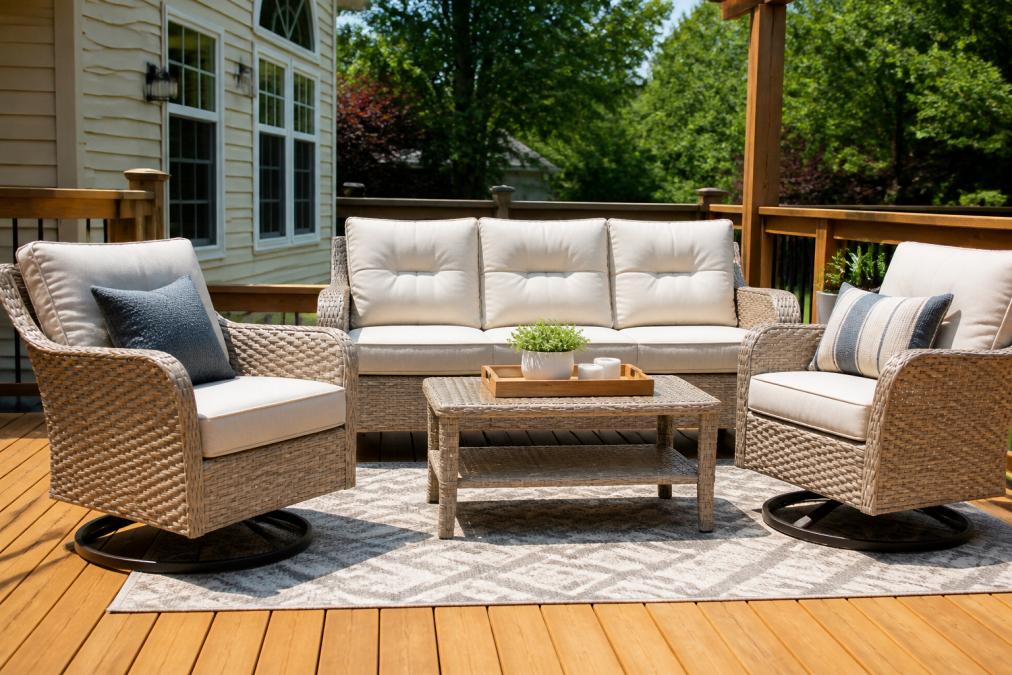
Best Overall: 9-Piece Wicker Patio Conversation Set with Swivel Chairs
Our top pick is the 9-Piece Wicker Patio Conversation Set with Swivel Chairs at $1,303.18. It pairs handwoven all-weather wicker with a heavy-duty powder-coated steel frame, and the two swivel rocker armchairs rotate a full 360 degrees with a 350 lb weight capacity each. The modular layout reconfigures corner, arm, and armless chairs to fit an awkward patio shape. Assembly takes patience, and the wicker still benefits from an occasional wipe-down.
Best Value: 5-Piece Wicker Patio Furniture Set with Ottomans
Budget shoppers should start with the 5-Piece Wicker Patio Furniture Set with Ottomans at $509.99. UV-resistant PE rattan sits over a rust-proof steel frame, and the two ottomans double as footrests or extra seating. Cushions are water-resistant with ergonomic support, and the set seats two comfortably. The tradeoff is a 300 lb chair capacity, so it suits lighter use.

Best for Large Families: 11-Piece Patio Furniture Set with Swivel Chairs
For a crowd, the 11-Piece Patio Furniture Set with Swivel Chairs at $2,473.30 delivers the most seating. The swivel-glide base rotates and rocks, and the 24-inch deep, 4-inch thick high-density foam cushions hold their shape. The frame uses anti-rust alloy steel for load-bearing stability. Note that this set ships in multiple packages that may arrive on different days.
Best for Small Patios: 7-Piece Rattan Conversation Set with Sectional Sofa
The 7-Piece Rattan Conversation Set with Sectional Sofa at $1,004.91 fits tight spaces without sacrificing seating. Rust-proof steel and commercial-grade wicker handle the seasons, and adjustable-height legs level the set on uneven decks. The shatterproof glass coffee table and spill-friendly cushions make it forgiving for everyday use. One caveat: the L-shape limits how you can rearrange a narrow balcony.

Solid Wood vs Plastic Outdoor Furniture: Which Lasts Longer?
Solid wood and plastic outdoor furniture last differently: wood can be sanded and refinished for decades, while plastic resists moisture but can become brittle and fade. Wood demands periodic sealing against moisture and UV exposure, but it can be repaired. Plastic needs almost no maintenance, yet a cracked or sun-bleached piece usually cannot be fixed, only replaced. For repairability, wood wins; for maintenance-free simplicity, plastic has a place. Wicker sets sit between the two, combining a steel frame with synthetic resin that resists fading and dry cracking.
Maintenance Tips for Long-Lasting Patio Chairs
Most outdoor furniture guides stop at "wipe it down and cover it." That keeps a chair presentable, but not structurally sound for a decade. The difference between a set that lasts three seasons and one that lasts ten comes down to four habits: cleaning the right way, protecting load-bearing joints, and replacing wear parts before they fail.
Cleaning Without Causing Damage
Wicker and metal frames should be wiped with a damp microfiber cloth and mild dish soap once a month during peak use. Rinse with a hose on low pressure and air-dry fully before replacing cushions. Never power-wash wicker or rattan, pressurized water forces moisture past the weave into the steel frame, which is where rust starts. Green or white oxidation weeping from the weave means water has already reached the frame.
Clean cushion covers according to the fabric care label. Most solution-dyed acrylic and olefin covers are machine washable on cold and should be air-dried, not tumble-dried, since heat shrinks zipper tape and breaks down the water-repellent finish (How To Clean Sunbrella Upholstery Fabric). For spot stains, a 1:10 bleach-to-water solution is safe on most solution-dyed fabrics but strips the finish on printed or cotton-blend covers (Sunbrella Cleaning Guide).
Protecting the Joints That Hold the Chair Together
Loose bolts cause frame wobble, and wobble eventually cracks welds. Tighten all visible hardware, typically hex bolts on the arm-to-seat and leg-to-frame connections, twice a year, in spring before the season and in fall before storage. Use a thread-locking compound on any bolt that keeps backing out. On swivel and glider bases, lubricate the rotation mechanism with a silicone-based spray, not WD-40, which attracts grit.
Touch up scratched powder coating within a few days. Matching touch-up paint stops surface rust from spreading under the coating; left alone, a coin-sized scratch can become a dinner-plate rust bloom in one humid season.
Replacing Wear Parts Before They Fail
This is the step almost every guide skips, and it is a significant factor in how long a set lasts. Cushions, slings, feet caps, and hardware are wear items designed to be replaced. Swapping them on schedule is far cheaper than a new chair and prevents the frame from absorbing stress it was not built for.
- Cushions: High-density foam loses roughly a third of its support after three to four seasons of daily use (pubmed.ncbi.nlm.nih.gov). When a cushion no longer springs back after you stand up, replace the foam insert rather than the whole cushion.
- Slings and mesh: Check for sagging, fraying at the attachment points, and fading. A sagging sling concentrates weight on the frame's stress points.
- Feet caps and glides: These protect the frame from ground moisture. Cracked or missing caps let water wick up into the legs.
- Hardware: Keep a small bag of spare bolts, washers, and caps in the same sizes the manufacturer uses.
How to Source Replacement Parts
Most buyers never think about this until something breaks, and by then the original listing may be gone. A few steps protect you:
- Save the assembly manual and hardware bag label. The manual lists bolt sizes and part numbers you will need later.
- Photograph the manufacturer label on the underside of the frame or the back of the cushion. It usually includes a model number and a customer-service contact.
- Contact the manufacturer directly first. Many brands sell replacement cushions, slings, and hardware kits even after a model is discontinued, often for years.
- If the manufacturer is gone, measure the cushion or sling and order a universal replacement. Cushion dimensions are standardized enough that a generic insert in the right size and thickness will fit most frames.
- For hardware, a local hardware store or online fastener supplier can match most hex bolts and washers by size and thread pitch.
A Simple Seasonal Maintenance Calendar
- Monthly during use: Wipe frames and wicker, rinse during pollen season, spot-clean cushions.
- Twice a year (spring and fall): Tighten all hardware, lubricate swivel and glider mechanisms, inspect feet caps, touch up scratches.
- Annually: Deep-clean cushion covers, check slings for sag, replace any worn foam inserts, restock spare hardware.
Climate and Storage: Making Lounge Chairs Last in Any Region
"Durable" means something different depending on where you live. A set that thrives on a covered desert patio may corrode in two seasons near the coast, and a set that handles salt air fine may grow mildew in a humid climate. Most buying guides treat weather resistance as one universal score. It is not. Here is how to match materials to your conditions, and store a set when you do not have a garage.
Coastal Climates: Salt Air and Corrosion
Salt air is the most aggressive common environment for outdoor furniture. Airborne chloride accelerates corrosion on exposed metal, attacking the frame at every scratch, weld, and bolt. The priority in coastal zones is a fully powder-coated aluminum or steel frame with no bare-metal contact points, plus stainless-steel hardware. Aluminum is generally better because it does not rust like steel, though it can pit if the coating is compromised.
- Rinse frames with fresh water monthly during the season to wash off salt deposits.
- Touch up any coating scratch immediately, salt air turns a small scratch into a corrosion site fast.
- Avoid untreated wrought iron and any furniture with visible bare welds.
- Choose solution-dyed acrylic cushions over cotton blends; salt air plus humidity is hard on natural fibers.
Desert and High-UV Climates: Sun Damage and Heat
In intense-UV regions, the sun, not moisture, is the enemy. UV breaks down fabric dyes, dries out wood, and makes plastic brittle. Prioritize UV-stabilized materials: solution-dyed acrylic fabric (color in the fiber, not printed on top), UV-protected PE wicker, and powder-coated frames that resist chalking.
- Expect to refinish or reseal wood more often, often annually in high-UV zones.
- Rotate cushions and flip them so fading is even.
- Avoid dark-colored cushions in full sun; they absorb heat and break down faster.
- Plastic resin furniture will fade and become brittle faster here than anywhere else.
Humid and Rainy Climates: Mold, Mildew, and Standing Water
Humidity and frequent rain create the opposite problem: moisture trapped in cushions, weave, and frame joints. Prioritize drainage and airflow. Choose frames with open weaves, cushions with quick-dry foam and mesh backs, and sloped or perforated seat surfaces that do not hold water.
- Store cushions indoors or in a ventilated deck box whenever rain is forecast for more than a day.
- Never stack wet cushions; trapped moisture between them is where mildew starts.
- Clean mildew promptly with a diluted bleach solution on solution-dyed fabrics.
- Avoid flat-topped arms and solid seat platforms that pool water.
Cold-Winter Climates: Freeze-Thaw Damage
Freeze-thaw cycles are hard on joints. Water seeps into small gaps, freezes, expands, and slowly loosens welds and bolts. Where temperatures drop below freezing, seasonal storage is the single biggest factor in how long a set lasts.
Off-Season Storage When Space Is Tight
Most guides say "store it in a garage" and stop there. If you do not have a garage, shed, or spare room, here is how to protect a set anyway:
- Stack and consolidate. Armless chairs and ottomans usually stack. Group them in the smallest footprint you can and cover the stack with a breathable cover.
- Use vertical space. Wall-mounted hooks in a shed or on a covered porch can hold folded chairs off the ground.
- Choose breathable covers, not tarps. A plastic tarp traps condensation against the frame and causes more rust than leaving the piece exposed. Look for covers with vents or mesh panels.
- Elevate off concrete. Concrete wicks moisture. Set frames on wooden pallets or blocks.
- Remove and store cushions indoors. Cushions are the most vulnerable and the easiest to relocate. A closet or under-bed space works fine.
- Disassemble if needed. Many modular sets break down into flat sections that store in far less space than the assembled piece.
When a Set Reaches End of Life
Before disposal, check whether the frame can be refurbished. Metal frames are almost always recyclable through municipal scrap-metal programs, and many synthetic wickers are recyclable where #2 or #4 plastics are accepted. Cushion foam is rarely recyclable curbside but is sometimes accepted at specialty foam recyclers. If the frame is sound and only the wear parts are shot, refurbishing, new cushions, new slings, fresh touch-up paint, is almost always cheaper and lower-waste than replacing the whole set.
Frequently Asked Questions
What material is best for long-lasting outdoor lounge chairs?
PE resin wicker over a powder-coated steel frame holds up best in most backyards. It resists fading, cracking, and rust without the refinishing that real wood needs. Teak and other hardwoods last decades but require occasional oiling. Aluminum frames stay light and rust-proof but can dent. The frame matters more than the weave: powder-coated steel or aluminum outlasts bare metal every time.
How do I maintain outdoor furniture to make it last longer?
Wipe wicker and frames with mild soap and water every few weeks during heavy-use months. Bring cushions inside or into a storage box when rain is forecast, and wash cushion covers per the care tag at season's end. Tighten bolts twice a year, and touch up any frame scratches with matching paint to stop rust before it spreads. Cover or store pieces during off-season months to protect them from ice and UV damage.
Is solid wood or plastic better for outdoor lounge chairs?
Solid wood like teak offers unmatched warmth, but it costs more and needs seasonal care. High-density plastic and resin furniture never needs refinishing and shrugs off rain, yet it can feel less substantial and may fade over time. For humid or coastal climates, resin wicker over a rust-proof frame often strikes the best balance of looks, comfort, and low upkeep.
What features should I look for in a durable outdoor lounge chair?
Check the weight capacity (300 to 350 pounds per chair is a solid benchmark), frame material (powder-coated steel or aluminum), and cushion fabric (olefin or solution-dyed acrylic resists fading and mildew). Look for high-density foam cushions that won't flatten after a season, and confirm replacement parts like cushions and hardware are available. Adjustable backrests and ergonomic deep seating add comfort without sacrificing durability.
Do expensive outdoor lounge chairs actually last longer?
Price tracks durability when the money goes into materials, not branding. A $1,000 set with a powder-coated steel frame, all-weather PE wicker, and high-density cushions typically outlasts a $300 set with thin metal and low-density foam by several seasons. The real test is repairability: if you can replace cushions, bolts, and wicker panels, a higher upfront cost pays off over 10 or more years of use.