
 ultimate-guide
How to Choose Durable Outdoor Furniture That Lasts
Table of Contents
- What Makes Outdoor Furniture Actually Durable
- Solid Wood vs Plastic Outdoor Furniture: An Honest Comparison
- How to Spot High-Quality Construction Before You Buy
- Matching Materials to Your Climate and Space
- How to Maintain Outdoor Furniture Through Every Season
- Pet- and Child-Friendly Choices That Still Last
- Conclusion
- Frequently Asked Questions
Last Updated: September 15, 2026
What Makes Outdoor Furniture Actually Durable
Durable outdoor furniture survives sun, water, temperature swings, and daily use without warping, cracking, or falling apart. At Backyard Comfort CO, we've seen that the difference between furniture lasting a few seasons and furniture lasting decades comes down to construction quality and material choice, not marketing claims. This guide covers how to choose durable outdoor furniture that holds up year after year.
Most buyers focus on style first and materials second. That's backwards. The frame, joinery, and finish determine whether your patio set survives its fifth summer or gets hauled to the curb. Below are the four failure points that destroy outdoor furniture and how to check for each one before you buy.
The Four Failure Points: Sun, Water, Temperature Swings, and Weight
Every piece of outdoor furniture eventually fails at one of four points. UV radiation breaks down finishes and fades fabric (the EPA). Moisture causes rust, rot, and mildew. Freeze-thaw cycles crack wood and split welds. Weight stress from sitting, wind, or dragging loosens joints over time.
A chair isn't durable because the label says so; it's durable because it resists all four forces at once.
Solid Wood vs Plastic Outdoor Furniture: An Honest Comparison
Solid wood and plastic outdoor furniture represent two different durability philosophies. Wood offers strength, repairability, and natural beauty but needs periodic maintenance. Plastic, including high-density polyethylene, resists moisture and never needs refinishing, yet it can fade, crack under load, and generally can't be repaired once damaged.
Here's how the two materials stack up:
| Factor | Solid Wood | Plastic (HDPE) |
|---|---|---|
| Weather resistance | Good, with finish upkeep | Excellent, low maintenance |
| Repairability | High, sandable and re-stainable | Low, replacement only |
| Weight and stability | Heavy, stays put in wind | Lighter, can shift |
| Lifespan | Decades with care | Long, but degrades in UV |
| Look and feel | Natural, warm, ages well | Uniform, can look synthetic |
Neither wins outright. Wood rewards homeowners willing to maintain it; plastic suits those who want zero upkeep and accept the trade-offs.
Repairability: The Question Nobody Asks
Repairability is the most overlooked durability factor. A scratched teak table can be sanded and refinished; a cracked plastic chair is trash. When evaluating how to choose durable outdoor furniture, ask whether parts, cushions, hardware, and slats can be replaced rather than the whole piece.
How to Spot High-Quality Construction Before You Buy
High-quality construction shows up in three places: welds, joints, and hardware. Run your hand along every welded joint. A good weld is smooth and continuous; a cheap one is lumpy, porous, or already rusting at the seam. Then check the joinery where the frame meets the legs or arms.
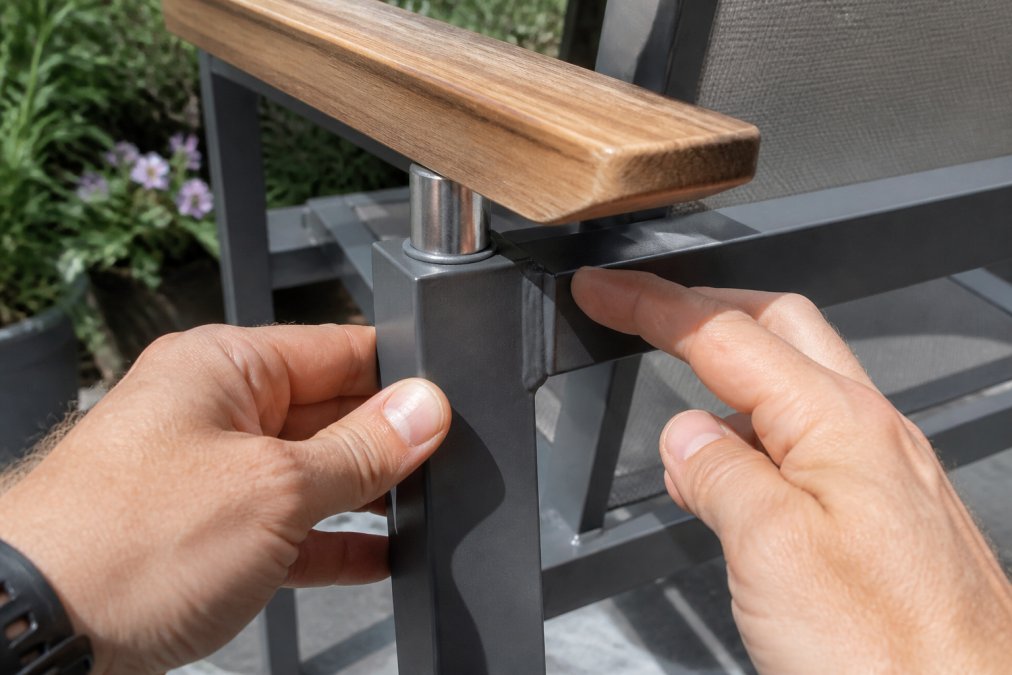
Welds, Joints, and Hardware: Where Cheap Furniture Fails First
Stainless steel hardware is the best indicator of a piece built to last. Ordinary steel screws and bolts rust within a season or two, staining the frame and weakening connections. Look for stainless steel or similarly corrosion-resistant fasteners, and confirm joints are welded or bolted through solid material, not stapled or glued.
- Welds: smooth, continuous, no rust bleed
- Joints: reinforced, not stapled or glued
- Hardware: stainless steel, not painted-over steel
- Finish: powder-coated aluminum or properly sealed wood
Matching Materials to Your Climate and Space
Climate should drive your material choice more than any trend, because each material handles the four failure points differently. Rather than memorizing brand names, learn which material fails first in your conditions.
Climate Zones and What Fails First
- Hot, humid, and sun-heavy: UV radiation and moisture do the damage. Powder-coated aluminum and high-density polyethylene (HDPE) resist both because they don't absorb water or feed mildew. Untreated steel rusts at scratched welds, and unfinished wood grows mildew in the grain. Synthetic wicker with a tight, high-density weave resists moisture better than loose open weaves that trap water.
- Dry and cold with hard freezes: Freeze-thaw cycles are the enemy. Water seeps into porous material, expands when it freezes, and splits it from the inside. Teak, sealed hardwood, and HDPE handle repeated cycles; thin-walled tubular metal and low-density resin crack at the seams.
- Coastal and salt-air: Salt accelerates corrosion on any ferrous metal. Marine-grade stainless steel (look for grade 304 or 316) and powder-coated aluminum survive; painted steel and zinc-plated hardware pit within a season or two (nasa.gov).
- Desert and high-UV: Fading and embrittlement dominate. Solution-dyed acrylic fabrics hold color far longer than surface-dyed fabrics because the pigment runs through the fiber rather than sitting on top of it. HDPE is UV-stabilized throughout; cheaper polypropylene degrades and chalks.
Homeowners often buy for the average day and get punished by the worst week of the year. Shop for your worst week.
Measuring Your Space the Right Way
Measure before you order, and measure more than the footprint. You need four numbers:
- Available footprint, the length and width of the patio or deck, minus any fixed obstacles like a grill, planter, or step.
- Clearance for movement, leave roughly 24 to 36 inches of walking space behind pulled-out chairs so people can pass without turning sideways.
- Table-to-wall distance, a dining table needs about 32 to 36 inches from the table edge to the nearest wall or rail so a seated person can push back and stand.
- Vertical clearance, account for an umbrella, a pergola, or an overhang before you commit to a taller table or a bar-height set.
Favor modular and stackable designs for odd or small footprints. Modular pieces reconfigure without new purchases, and stackable chairs free up floor space off-season.
The Repairability Test: The Question Almost Nobody Asks
Before you buy, run a five-minute repairability test. It's the best predictor of whether a piece lasts a decade or a season, and the factor most buyers never check.
- Can you buy replacement cushions? A frame that outlasts its cushion is only durable if the cushion can be reordered. If the fabric is a proprietary pattern with no replacement program, the whole set is disposable.
- Are the fasteners standard? Stainless steel bolts in standard sizes can be replaced at any hardware store. Proprietary clips and riveted joints cannot.
- Are slats, arms, or legs sold individually? Furniture with available spare parts routinely outlasts "maintenance-free" pieces that become unusable after one damaged component.
- Is the finish field-repairable? Powder coat can be touched up with a matching paint pen; anodized or plated finishes generally cannot.
Ask the seller two questions before checkout: "Do you sell replacement cushions and hardware?" and "Are the fasteners standard stainless steel?" If the answer to either is no, you're buying a disposable set regardless of what the label claims.
A Quick Torture Test You Can Do in the Store
You can't simulate five summers in a showroom, but you can find weak points in about two minutes:
- Rock the chair. A frame that flexes or creaks under a gentle push has loose joinery.
How to Maintain Outdoor Furniture Through Every Season
Material-Specific Care
The Maintenance Schedule That Works
| Season | Task | Frequency |
|---|---|---|
| Spring | Inspect joints, tighten hardware, touch up finish chips | Once |
| Summer | Clean fabric and wipe frames, rinse hardware | Monthly |
| Fall | Apply wood sealer, deep clean, inspect for cracks | Once |
| Winter | Cover furniture, store cushions indoors, check straps | Once |
Repair Before You Replace
The maintenance schedule matters less than the habit. Ten minutes a month of cleaning and inspection prevents the rust, mildew, and loose joints that force premature replacement. And when something does fail, check whether it's a part you can replace before you assume it's a piece you have to replace.
Pet- and Child-Friendly Choices That Still Last
Families with young children and pets who want furniture that stays stable, cleans easily, and survives daily rough use without constant repairs.
Conclusion
Frequently Asked Questions
What is the most durable material for outdoor furniture?
Powder-coated aluminum and teak wood consistently outperform other materials for durability. Aluminum resists rust and handles coastal humidity well, while teak's natural oils make it resistant to rot and insects. Synthetic wicker over an aluminum frame also holds up well in intense sun. The frame matters as much as the surface material, so check for welded joints and stainless steel hardware before buying durable outdoor furniture.
Does solid wood or plastic furniture last longer outdoors?
Solid wood, with basic maintenance, and high-density polyethylene (HDPE) furniture, with almost no upkeep, can both offer long lifespans. The trade-off is repairability: wood can be sanded and refinished, while plastic usually cannot. In freeze-thaw cycles, wood flexes better, but plastic resists moisture entirely. Your climate and willingness to maintain the pieces should drive the choice.
How do I know if outdoor furniture is high quality?
Check the welds on metal frames (they should be smooth, not lumpy), confirm hardware is stainless steel rather than painted steel, and press cushions to see if they spring back. Look for powder-coated aluminum, all-weather fabric like olefin or acrylic, and load-bearing capacity ratings. If a piece feels light for its size, the frame is probably thin. These checks separate durable outdoor furniture from pieces that fail in two seasons.
How can I tell if wood furniture is weather-resistant?
Teak, ipe, and acacia are naturally weather-resistant due to their density and oil content. Ask whether the wood is kiln-dried, which prevents warping and cracking. Look for tight grain and minimal knots. If the wood feels light or has visible gaps, it will absorb water and fail in freeze-thaw cycles. A factory-applied finish helps, but naturally rot-resistant species are the better long-term investment.