
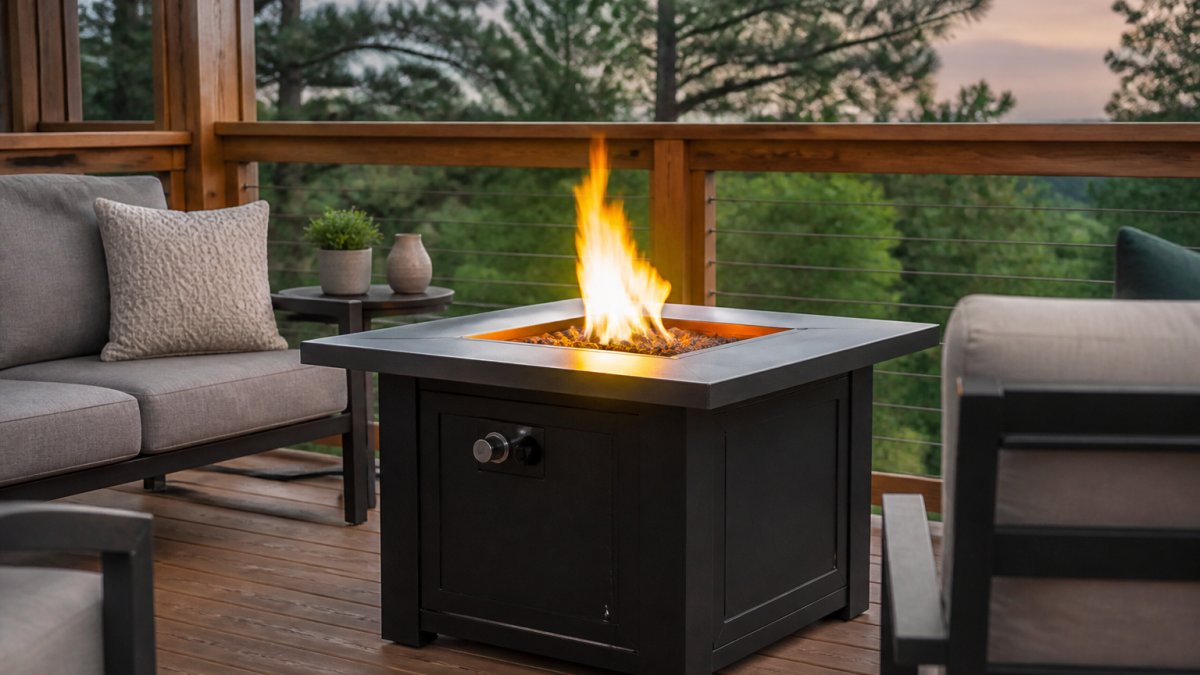
 listicle
Best Propane Fire Pit for Deck: 7 Top Picks Reviewed
Table of Contents
- What to Look for in a Propane Fire Pit for Deck Use
- Fire Pit Clearance Requirements for Decks
- 1. 48 In. 50,000 BTU Rectangle Outdoor Propane Gas Fire Pit Table in Brown
- 2. 30 In. Round Firepit Table, 50,000 BTU (White with Black Dots)
- 3. 39 In. Tabletop Concrete Gas Fire Pit, 50,000 BTU
- 4. 56" x 32" Cast Concrete Fire Table with Lava Rocks, 45,000 BTU
- Fire Pit Deck Protection Mat: Why You Need One
- How to Hide Propane Tank for Fire Pit on a Deck
- Frequently Asked Questions
Last Updated: September 30, 2026
What to Look for in a Propane Fire Pit for Deck Use
A propane fire pit for deck use must throw enough heat to keep people outside after sunset, on a surface never designed to hold open flame. This guide covers the specs that matter, then reviews four fire tables that meet them.
The most common mistake is shopping on looks first and BTU output second. A fire table that photographs beautifully but produces weak heat becomes decorative by October.
Three specifications decide whether a unit works on a deck:
- BTU output determines how much area you can heat
- Ignition type determines how reliably it starts and how safely it shuts off
- Clearance and weight determine whether your deck structure and railing allow it at all
Get those three right and the rest is style preference.
BTU Output and Heat Radius
BTU output measures how much heat a gas appliance produces per hour and sets the heat radius you can expect. Most full-size deck fire tables land between 45,000 and 50,000 BTU, enough to warm four to six people in still air.
Two factors shrink that radius: wind strips heat sideways, and low table heights push warmth at shin level rather than torso level. A 50,000 BTU fire table with a wind guard often feels warmer than a higher-output unit without one.
If your deck sits in an exposed spot, prioritize a unit with a glass wind guard or a deeper fire bowl over one with a higher BTU rating.
Ignition Systems and Safety Certification
Electronic and pulse ignition systems start with a push button and adjust flame height from a knob, while manual ignition requires a match at the burner. Electronic ignition is worth the small added cost on a deck, because you are not leaning over the burner to light it.
Safety certification matters more than any other spec. Look for a CSA mark on the rating plate, which confirms independent testing for gas connections, burner performance, and automatic shut-off. A thermocouple or auto safety shut-off cuts gas flow if the flame goes out, preventing a propane smell from becoming a real problem.
Fire Pit Clearance Requirements for Decks
Clearance requirements for a propane fire pit on a deck come down to four distances: from the railing, from siding or a wall, from anything combustible overhead, and from the deck edge. Manufacturer instructions and the rating plate are the authority for your model, so read them first. What follows is the planning framework most installers use when the manual is silent.
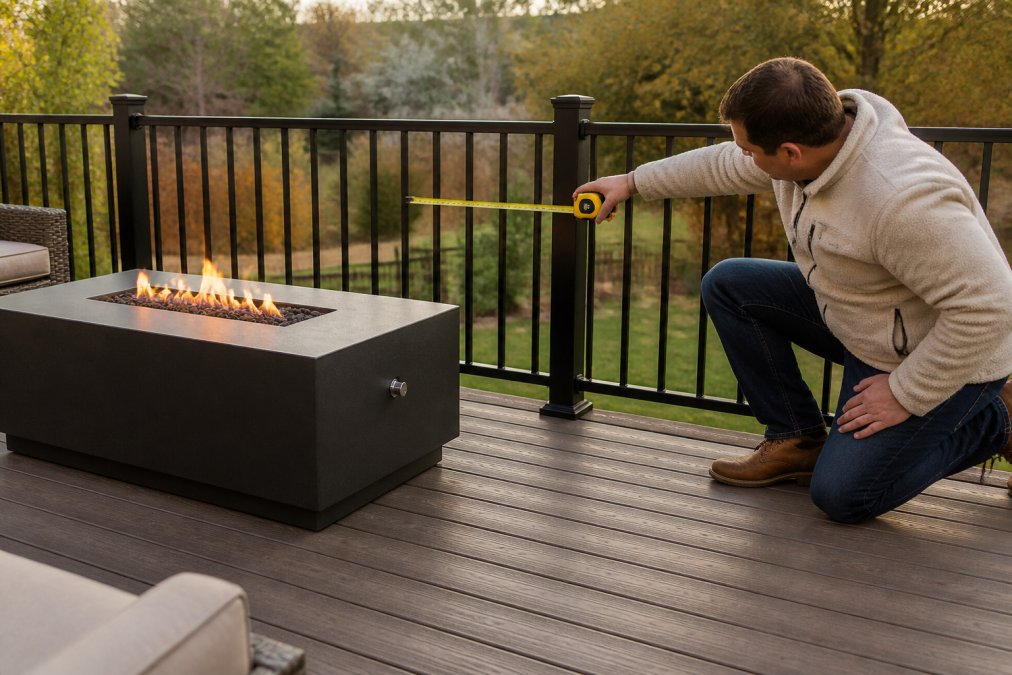
Railing and combustible walls. Plan for at least 3 feet of open space around the fire bowl, and more where people walk past. Vinyl is the most heat-sensitive and can sag or discolor well before it chars; wood and composite scorch and dry out over repeated exposure. Composite decking is more heat-sensitive than most people assume, so treat the railing and the deck surface as two separate clearance problems.
Siding and walls. A fire table pushed against a house wall is the most common placement mistake. Vinyl siding can warp at temperatures that feel comfortable two feet away, and the heat plume rises along the wall rather than dispersing. Keep the burner at least 3 feet from any wall, and more if the wall is vinyl or has a window above it.
Overhead clearance. This is the requirement buyers forget. A pergola, awning, second-story balcony, or low tree branches all count as overhead obstructions, and none belong directly above an open flame.
Propane Fire Pit, Outdoor Concrete Gas →
| Clearance Type | Minimum Planning Distance | Why It Matters |
|---|---|---|
| Railing and combustible walls | 3 feet | Radiant heat warps vinyl and scorches wood |
| Siding and house walls | 3 feet, more for vinyl | Heat plume rises along the wall and can warp siding |
| Overhead structures | No obstruction directly above | Rising exhaust damages and can ignite |
| Seating and walkways | 3 feet | Keeps guests and fabric clear of the flame |
| Deck edge | 12 inches in from the edge | Prevents leaning over flame and fascia scorching |
| Propane tank | Outside the fire bowl footprint | Heat exposure and hose routing |
1. 48 In. 50,000 BTU Rectangle Outdoor Propane Gas Fire Pit Table in Brown
The 48-inch rectangle in matte brown is the most practical starting point for a deck and our top pick for most households. It delivers up to 50,000 BTU through a durable steel body, uses electronic ignition, and gives you adjustable flame control at the knob.

2. 30 In. Round Firepit Table, 50,000 BTU (White with Black Dots)
Round fire tables suit compact decks because people can sit at any angle without a long straight edge to plan around. This 30-inch model matches the rectangle at 50,000 BTU and carries CSA safety certification, the mark worth checking first.

3. 39 In. Tabletop Concrete Gas Fire Pit, 50,000 BTU
This 39-inch tabletop unit is the one to choose for concrete looks without a permanent installation. It runs on propane with no smoke or ash, and the H-shaped double-layer stainless steel burner pushes up to 50,000 BTU with a full, bright flame.

4. 56" x 32" Cast Concrete Fire Table with Lava Rocks, 45,000 BTU
The 56" x 32" cast concrete table is the statement piece of this group, the one to buy if your deck is large and you want the fire table to anchor the seating area. It is CSA and CE certified, built from cast concrete with a stainless steel burner, and equipped with electric ignition and auto safety shut-off.
Fire Pit Deck Protection Mat: Why You Need One
A fire pit deck protection mat is a heat-resistant barrier placed under and around the fire table to shield deck boards from radiant heat, spilled ash, and grease. It is the cheapest insurance for a wood or composite deck, and the accessory most buyers skip until they see a scorch ring.
A quick weight check before you buy:
- Find the table's shipping weight or product weight in the spec sheet.
- Add roughly 37 pounds for a full 20-lb propane tank, plus the weight of any lava rock or glass media.
- Divide that total by the square footage of the table's footprint (length times width of the base, not the tabletop).
- Compare the result to your deck's rated load. If you do not know the rating, a structural engineer or your local building department can tell you what applies to your deck.
How to Hide Propane Tank for Fire Pit on a Deck
The cleanest way to hide a propane tank for a fire pit on a deck is the tank hideaway built into the fire table itself, which keeps the tank out of the heat path and off the walking surface. Several units in this lineup include that compartment as standard.
- Matching side table with a storage cavity: keeps the tank at table height and visually consistent
- A dedicated propane tank cover sized to a 20-lb tank: the simplest fix, and it doubles as weather protection
- A low deck storage bench positioned beside the table: hides the tank and adds seating
Frequently Asked Questions
Can a propane fire pit be used on a deck?
Yes, a propane fire pit can be used on a deck when you follow clearance and safety guidelines. Keep the unit at least 3 feet from railings and siding, and place it on a fire pit deck protection mat to shield the surface from heat. Choose a CSA-certified model with an auto safety shut-off and adjustable flame control. Never operate it under a covered roof or overhang, and always check your local fire codes before use.
What is the best propane fire pit for a deck?
The best propane fire pit for deck use depends on your space and heating needs. A 30-inch round table with 50,000 BTU and CSA certification works well for smaller decks. For larger gatherings, a 48-inch rectangular model at 50,000 BTU provides broader heat coverage and a tank hideaway. Look for electronic ignition, adjustable flame settings, and a weather-resistant cover included.
Do I need a heat shield for a propane fire pit on a wood deck?
A heat shield or fire pit deck protection mat is strongly recommended on a wood deck. These mats create a barrier between the fire pit base and the wood surface, reducing the risk of heat damage and scorch marks. Even CSA-certified units rated for deck use benefit from a mat, especially during extended burns. Place the mat directly under the fire pit before lighting.
How long will a 20-lb propane tank last on a fire pit?
A standard 20-lb propane tank typically lasts 8 to 10 hours on a fire pit set to medium flame. At full 50,000 BTU output, expect closer to 6 to 8 hours. Lower flame settings extend burn time significantly. If you plan frequent use, keep a spare tank on hand or choose a model with a tank hideaway that fits a standard 20-lb tank for easy swapping.
Are propane fire pits better than wood-burning for decks?
Propane fire pits are generally better for decks because they produce no smoke, ash, or flying embers that can damage wood surfaces. They light instantly with electronic or pulse ignition and offer adjustable flame control. Wood-burning pits require more clearance and produce residue that can stain decking. For a cleaner, safer deck experience, propane is the practical choice.